

The Real Cleaning Challenge: It's About Time, Not Equipment
Most households today do not face problems with cleaning equipment. They struggle with time. People postpone cleaning tasks, rush through them, or skip them entirely. This happens not because tools are ineffective, but because daily routines are overloaded. This reality has fundamentally changed the role vacuum cleaners play in modern homes.
Our Top Vacuum Cleaner Picks for Indian Homes
Here are some excellent options available in the Indian market:
- Eufy L60 Hybrid Robot Vacuum Cleaner with Mop: Features ultra-strong 5,000 Pa suction, iPath laser navigation, and works ideally on hard floors. Price: ₹10,999
- NUUK REN PRO Stick Cordless Vacuum Cleaner: Offers 2X more suction with 34kPa power, adaptive suction technology, and comes with 8 attachments. Price: ₹19,999
- ECOVACS Deebot N30 PRO Omni Robotic Vacuum Cleaner: Provides 10,000 Pa suction, self-emptying station, and hot air-drying features. Price: ₹54,999
- AGARO Supreme Cordless Stick Vacuum Cleaner: A 2-in-1 handheld and stick vacuum with 25 kPa suction power and three adjustable modes. Price: ₹14,999
- NARWAL Freo Z Ultra Robot Vacuum & Mop: Boasts 12,000Pa suction, dual RGB cameras, and AI avoidance technology. Price: ₹79,990
Two Different Solutions to Time Pressure
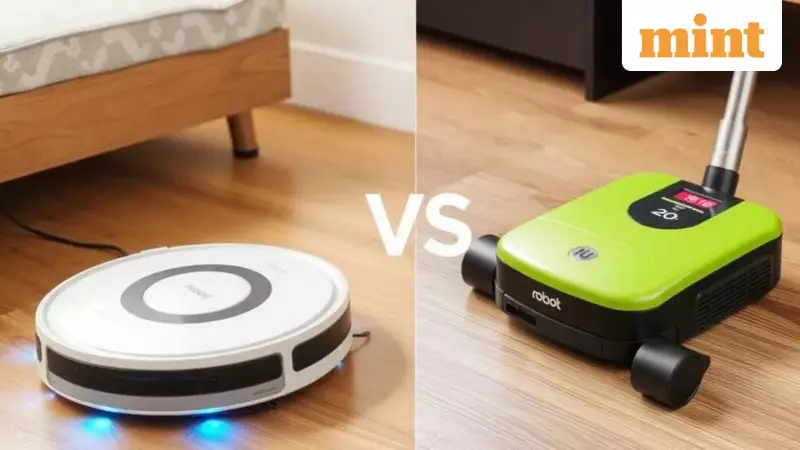
Robot vacuum cleaners and cordless vacuum cleaners represent two distinct responses to time pressure. One reduces human involvement completely, while the other minimizes setup time and effort. Their relevance depends more on how cleaning fits into daily behavior than on machine power alone.

Comparing both types side by side reveals important insights. Time availability, cleaning frequency, and effort tolerance shape long-term satisfaction far more than feature lists do.
Robot Vacuum Cleaners: Pros and Cons
Robot vacuum cleaners prioritize automation over raw cleaning power. Once properly set up, they operate independently. These devices follow scheduled cycles that maintain floor cleanliness with minimal user involvement. Their primary purpose is not deep cleaning but preventing everyday dust and debris accumulation.
In many homes, vacuuming gets skipped not because it's difficult, but because it's easy to delay. The best robot vacuum cleaners address this gap by cleaning regularly. They remove dust, crumbs, and pet hair before these become visible problems. Over weeks and months, this maintenance-focused approach reduces how often manual vacuuming becomes necessary.
The biggest advantage is truly hands-free operation. Cleaning happens in the background while people work, rest, or leave the house. Compact designs allow these devices to clean under furniture and in low-clearance spaces that often get ignored during manual cleaning. Modern navigation sensors and room mapping improve efficiency by reducing random movement and missed spots.
However, even the best robot vacuum cleaners have clear limitations. Their suction power typically falls below cordless or upright vacuums. This makes them less suitable for deep carpet cleaning or handling heavy debris. Cluttered floors can interrupt cleaning cycles, and some basic preparation is often required before operation.
Cordless Vacuum Cleaners: Pros and Cons
Cordless vacuum cleaners emphasize flexibility and direct user control. They require manual operation but eliminate the inconvenience of power cords and heavy designs. Their key advantage is immediacy. Cleaning can begin the moment dirt or spills appear, with virtually no setup or scheduling required.
The best cordless models deliver stronger suction than most robot vacuum cleaners. This makes them better suited for carpets, rugs, upholstery, mattresses, and corners. Their lightweight construction allows easy movement across rooms, stairs, and varied floor surfaces. Many models convert into handheld units, making them useful for furniture, shelves, and car interiors.

These vacuum cleaners give users precise control. They allow specific problem areas to be cleaned directly rather than relying on automated patterns. Maintenance remains simple, with easy-to-empty dust bins and fewer moving parts. They handle detailed cleaning tasks effectively, including skirting boards and soft furnishings.
However, cordless vacuum cleaners demand manual effort and time commitment. Battery life is limited, typically lasting 20 to 60 minutes depending on power mode. Cleaning sessions may pause for recharging. They don't provide automatic daily maintenance, and suction power can reduce as the battery drains. Higher-performance models with extended battery life often come with premium price tags.
Choosing What Works for Your Lifestyle
Robot vacuum cleaners and cordless vacuum cleaners serve different purposes rather than competing directly. Robot vacuums excel at maintaining cleanliness through regular, automated cleaning. They reduce daily effort and help keep floors consistently tidy, especially in busy households with packed schedules.
Cordless vacuum cleaners focus on control, power, and flexibility. They handle deeper cleaning, spot cleaning, stairs, and upholstery more effectively. They remain essential for thorough cleaning sessions and detailed tasks that require human attention.
For many Indian homes, the optimal solution involves using both types together. Robot vacuum cleaners handle routine maintenance, while cordless vacuums manage deeper and more targeted cleaning needs. This combination addresses both time constraints and cleaning thoroughness effectively.





