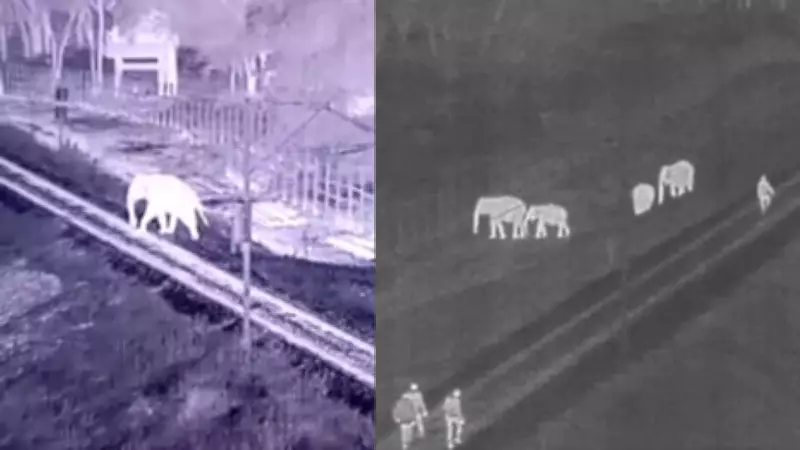
The Coimbatore Forest Department has reported zero elephant deaths on railway tracks in the region for the past year, attributing this success to an artificial intelligence (AI) surveillance system. The system uses thermal cameras and real-time alerts to detect elephants near tracks and warn train drivers, effectively preventing fatal collisions.
How the AI System Works
Installed along critical stretches of the Coimbatore-Mettupalayam railway line, the surveillance network comprises 20 thermal cameras that monitor elephant movement 24/7. When an elephant is detected within 100 meters of the tracks, the system sends an instant alert to a control room and directly to train loco pilots via a mobile app. This allows trains to slow down or stop in time to avoid accidents.
The AI technology, developed in collaboration with the Wildlife Institute of India and a private tech firm, uses machine learning to distinguish elephants from other animals or objects. It has achieved a detection accuracy of over 95%, according to forest officials.

Impact on Elephant Conservation
Before the system's implementation, the Coimbatore forest division recorded an average of three to five elephant deaths annually due to train hits. Since the AI surveillance began in January 2023, not a single elephant has been killed on the tracks. This milestone is significant for the region, which is part of the Nilgiri Biosphere Reserve and hosts a large elephant population.
District Forest Officer A. Venkatesh stated, “The AI system has been a game-changer. It has not only saved elephant lives but also reduced train delays and human-elephant conflict. We are now planning to expand the network to other vulnerable routes.”
Challenges and Future Plans
Despite the success, officials acknowledge challenges such as maintaining the cameras in dense forest areas and ensuring uninterrupted power supply. The forest department is exploring solar-powered cameras and drone surveillance to cover more remote sections.
The initiative has drawn praise from conservationists and railway authorities. A senior railway official commented, “This technology proves that innovation can harmonize development with wildlife conservation. We are committed to supporting such measures.”
With the system proving effective, the Coimbatore model is being studied for replication in other elephant corridors across India, including Assam and West Bengal.