

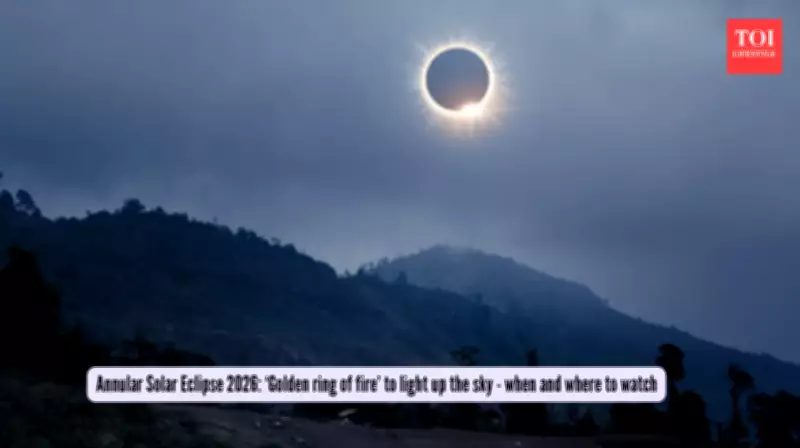
Annular Solar Eclipse 2026: Golden 'Ring of Fire' to Illuminate Antarctic Skies
An annular solar eclipse represents one of those rare and breathtaking celestial events that transforms the daytime sky into a spectacle of cosmic precision. The Sun morphs into a brilliant, glowing golden ring, creating what observers poetically call the "ring of fire." Witnessing this phenomenon offers a profound reminder of the perfectly timed orbital dance between Earth, the Moon, and the Sun—a silent, awe-inspiring moment that has captivated humanity for centuries.
What Exactly Is an Annular Solar Eclipse?
An annular eclipse occurs when the Moon passes directly in front of the Sun but does not completely obscure it. This happens because the Moon is at a farther point in its orbit around Earth, making it appear slightly smaller in the sky. As a result, the edges of the Sun remain visible, forming a luminous ring around the dark silhouette of the Moon. Unlike a total solar eclipse, the sky does not turn dark; instead, it remains bright with only a subtle dimming. The striking visual of this glowing circle is what makes annular eclipses so uniquely mesmerizing and unforgettable for skywatchers.
Annular Solar Eclipse 2026: Key Details and Viewing Information
Astronomy enthusiasts are eagerly preparing for the annular solar eclipse scheduled for February 17, 2026. The "ring of fire" will be visible along a narrow, extensive path stretching thousands of kilometers across the Earth's surface. According to reports from Space.com, only individuals positioned within this specific path of annularity will experience the full golden ring effect. Outside this band, observers in adjacent regions will witness a partial eclipse, which, while still intriguing, lacks the complete ring spectacle.

Date and Timing: The annular solar eclipse is set for February 17, 2026. Based on data from Time and Date, the main ring phase is projected to occur approximately between 11:42 am and 12:41 pm UTC. In optimal viewing locations, the full "ring of fire" will be visible for nearly an hour. This event marks the first solar eclipse of 2026, with a total solar eclipse also anticipated later in the year during August.
Where Will the Eclipse Be Visible?
The full annular eclipse will primarily be observable over Antarctica and sections of the Southern Ocean. The eclipse path initiates near the Antarctic region and traverses remote oceanic areas before concluding. Partial eclipse visibility may extend to parts of South America, as well as regions of the southern Atlantic and Pacific Oceans, where observers will see the Sun partially covered without the golden ring effect. As EarthSky humorously noted, this eclipse is largely "for penguins," highlighting the remote and inaccessible nature of the prime viewing zones this time.
Visibility in India and Safety Precautions
Unfortunately, the annular solar eclipse of February 17, 2026, will not be visible from India or most Northern Hemisphere locations. Indian skywatchers will miss out on both the "ring of fire" and any partial eclipse views, necessitating reliance on livestreams and photographs from southern regions.
Essential Safety Tips:
- Never gaze directly at the Sun with unprotected eyes, even during an eclipse, as this can cause permanent eye damage that may not be immediately felt.
- If watching from a visible region, use certified solar viewing glasses or appropriate solar filters.
- Consider indirect methods like a pinhole projector for safe observation.
While this eclipse may be distant for many, future events closer to home will occur, emphasizing the importance of preparedness for safe and enjoyable viewing experiences.






