

Artemis II Astronauts Complete Historic Flyby Beyond the Moon
In a monumental achievement for space exploration, the Artemis II astronauts recently conducted a flyby beyond the Moon, marking the first such mission since the Apollo era in 1972. This bold step by NASA signifies a return to lunar orbits, with four astronauts venturing to the far side of the Moon, which is not visible from Earth. The crew is scheduled to return by approximately 5:23 a.m. IST on April 11, 2026. This mission has not only filled the astronauts with excitement but has also sparked immense curiosity among people on Earth about their experiences and observations in space.
Unprecedented Observations During the Lunar Flyby
The Artemis II crew, consisting of Reid Wiseman, Victor Glover, Christina Koch, and CSA astronaut Jeremy Hansen, embarked on a seven-hour flyby of the Moon's far side on April 6, 2026. During this journey, they snapped thousands of groundbreaking photos that are set to revolutionize our understanding of the lunar surface. According to NASA, these images, released starting April 7, showcase untouched lunar regions, including detailed views of craters, ancient lava flows, and geological fractures. These photographs are instrumental in helping scientists map the Moon's ancient history and geological evolution.
The team meticulously tracked various lunar features, such as terrain colors, brightness levels, and textures. They also documented earthset and earthrise events, along with six meteoroid flashes on the dark lunar surface. However, the most incredible aspect of the flyby was the observation of a unique solar eclipse, a phenomenon that would never be witnessed from Earth.

Rare Solar Eclipse Spotted from Deep Space
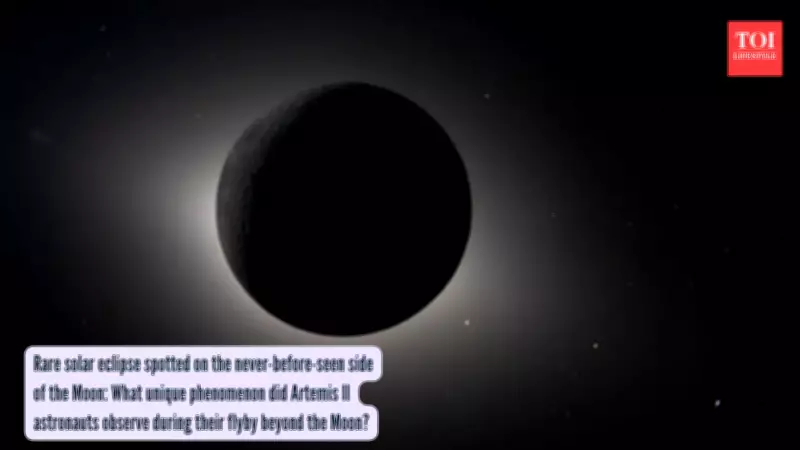
A rare in-space solar eclipse, visible only from their deep-space vantage point, emerged as the real treasure of the mission. As the astronauts looped around the far side of the Moon, the Sun remained fully eclipsed by the Moon for an impressive 54 minutes of totality. This duration is significantly longer than Earth's typical few-minute eclipses, allowing the crew to capture stunning images of the Sun's glowing corona halo. Additionally, visible stars, planets like Venus or Mars and Saturn in some shots, and faint lunar features such as Mare Crisium, illuminated by Earthshine, were documented.
Unlike Earth-based views, which always show the near side of the Moon, the astronauts had the unique opportunity to see the hidden far side silhouetted against the eclipsed Sun. This provided unprecedented insights into lunar topography and celestial dynamics.
Additional Discoveries and High-Resolution Imagery
High-resolution shots from the mission captured close-up views of Vavilov Crater, earthset over cratered lunar rims, and the Orion spacecraft framed against the eclipsed Sun. Typically, stars do not appear in bright space photographs due to exposure settings, but the totality of the eclipse made them visible, adding to the ethereal beauty of the images. The crew has proposed naming two far-side craters "Integrity" and "Carroll" in honor of their spacecraft and Wiseman's late wife, respectively.
Dr. Nicky Fox, NASA Science Mission Directorate associate administrator, praised the mission, stating, "Our four Artemis II astronauts — Reid, Victor, Christina, and Jeremy — took humanity on an incredible journey around the Moon and brought back images so exquisite and brimming with science, they will inspire generations to come." This sentiment was echoed in a BBC report, highlighting the mission's significance.
Future Implications and Ongoing Mission
More images are expected as the crew heads home, nearly completing their trip that launched on April 1. This flyby, which set a record for the farthest humans have traveled from Earth at 406,771 kilometers, serves as a critical test of technology for future Moon landings and eventual missions to Mars. The data and imagery collected will not only advance scientific knowledge but also pave the way for sustained human exploration of deep space.






