

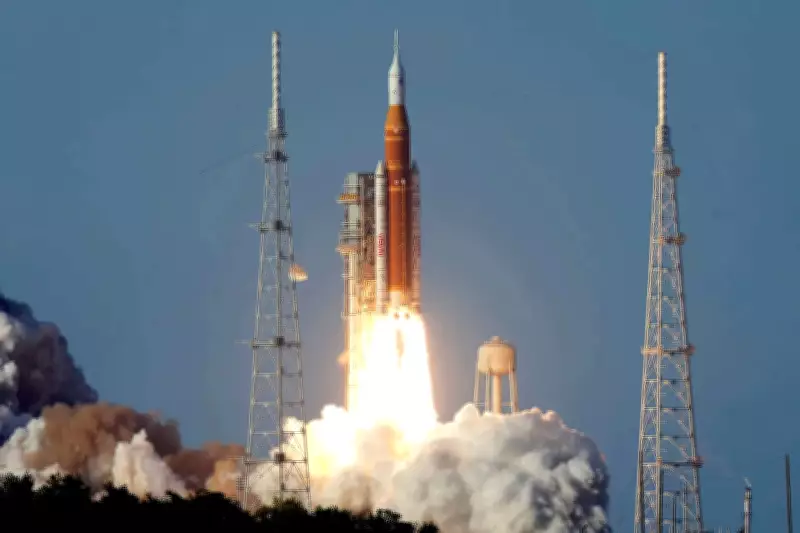
Historic Artemis II Mission Launches from Florida, Marking Return to Lunar Exploration
At precisely 3:54 AM Indian Standard Time on Thursday, a monumental 322-foot rocket illuminated the predawn skies over Florida, propelling four astronauts beyond Earth's orbit for the first time in 54 years. NASA's Artemis II mission is now officially underway, with the Moon approximately six days away from the spacecraft's current trajectory.
Powerful Launch and Initial Flight Phases
The Space Launch System (SLS) rocket and its Orion spacecraft, christened "Integrity" by its crew, lifted off from Launch Complex 39B at Kennedy Space Center at 6:35 PM Eastern Daylight Time on April 1. The initial thrust came from twin solid rocket boosters that ignited first, providing more than 75% of the power required to lift the massive 5.75-million-pound vehicle off the launch pad. Combined with the four RS-25 engines already operating at full capacity, the launch generated an astonishing 8.8 million pounds of force at liftoff. Mission control erupted in cheers as the vehicle successfully cleared the launch tower.
The early stages of the flight proceeded exactly according to plan. The two solid rocket boosters separated safely as scheduled, followed shortly by the separation of Orion's launch abort system, which exposed the spacecraft to the vacuum of space for the very first time. Approximately 50 minutes after liftoff, the interim cryogenic propulsion stage fired its main engine, raising the orbit's low point to a secure 115 miles. Nearly two hours into the mission, the upper stage engine fired again for about 18 minutes, elevating the orbit's high point to an impressive 43,760 miles.

System Deployment and Crew Preparations
Following these critical maneuvers, Orion's four solar array wings deployed successfully. Flight controllers at NASA's Johnson Space Center in Houston confirmed that all four arrays unfolded precisely as planned, locked securely into position, and immediately began drawing power from the sun.
The four-member crew now faces important preparatory work before embarking on their lunar journey. They will spend their initial 24 hours in space orbiting Earth while conducting comprehensive system checks on the Orion capsule. These evaluations will cover communications systems, navigation equipment, propulsion mechanisms, maneuvering capabilities, and life support systems. This careful testing phase occurs while the spacecraft remains sufficiently close to Earth to enable a rapid return should any significant problems arise.
Only after all systems pass rigorous inspection will the crew initiate the engine burn that will send them on their four-day coast toward the Moon.
NASA Leadership Emphasizes Mission Significance
NASA's top officials emphasized the profound importance of this milestone moment. NASA Administrator Jared Isaacman declared, "Aboard Orion are four remarkable explorers preparing for the first crewed flight of this rocket and spacecraft, a true test mission that will carry them farther and faster than any humans in a generation. Artemis II represents the beginning of something far greater than any single mission. It signifies our return to the Moon, not merely for visitation purposes but with the ultimate goal of establishing a permanent presence on our lunar base, while simultaneously laying essential groundwork for future monumental achievements."
Associate Administrator Amit Kshatriya added further context, stating, "Over the coming ten days, astronauts Reid, Victor, Christina, and Jeremy will thoroughly test Orion's capabilities so that subsequent crews can journey to the Moon's surface with complete confidence. We have completed just one mission within an extensive campaign, and the work awaiting us surpasses what we have already accomplished."

Mission Timeline and Lunar Objectives
The mission's most anticipated moment is scheduled for April 6, when the crew is expected to make their closest approach to the Moon, assuming all continues according to plan. During this planned multi-hour lunar flyby, the astronauts will photograph and conduct detailed observations of the Moon's surface, becoming the first humans to visually examine certain regions of the far side. Following this lunar encounter, the crew will embark on a looping figure-eight trajectory back to Earth, culminating in a splashdown landing in the Pacific Ocean currently projected for April 10.
This historic mission represents humanity's most significant step toward renewed lunar exploration since the Apollo program concluded more than five decades ago. The successful launch marks not just a technological achievement but a symbolic renewal of humanity's commitment to exploring beyond our planetary boundaries.
