

Chennai Scientists Transform Food Waste into Clean Energy with Banana and Cauliflower Residues
In a significant breakthrough for sustainable energy, researchers based in Chennai have discovered that common kitchen waste items—banana peels and cauliflower stems—can dramatically enhance biogas production while providing substantial environmental benefits. This innovative approach not only addresses food waste management but also contributes to reducing carbon dioxide emissions through increased clean energy generation.
Low-Cost Biogas Technology Developed at CSIR-CLRI
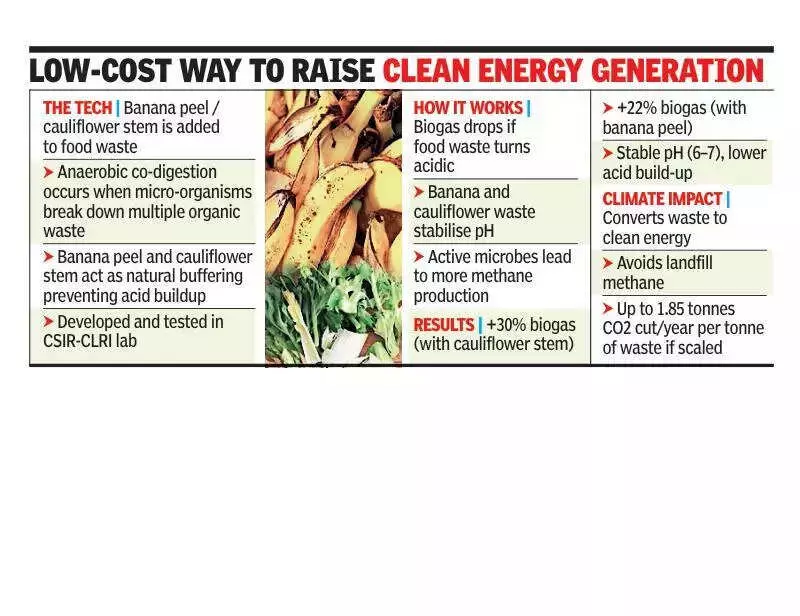
Scientists at the CSIR – Central Leather Research Institute (CSIR-CLRI) in Chennai have pioneered a cost-effective biogas technology that utilizes banana peel and cauliflower stem waste to stabilize food-waste digesters. This method significantly boosts the production of clean energy, offering a practical solution for urban waste management and renewable energy needs.
How Anaerobic Co-Digestion Works
The technology is grounded in anaerobic co-digestion, a microbial process where food waste breaks down in oxygen-free conditions to produce biogas. When food waste decomposes alone, it rapidly becomes acidic, which inhibits methane-producing microbes and reduces gas output. The Chennai researchers ingeniously countered this by incorporating naturally alkaline banana peels and cauliflower stems as biological buffering agents.

Laboratory Experiments and Key Findings
The system underwent rigorous testing through 30-day laboratory-scale batch digestion experiments. Food waste sourced from local restaurants and a university mess hall was combined with banana peel or cauliflower stem waste in a 70:30 ratio. Researchers meticulously monitored various parameters, including biogas production, pH levels, alkalinity, volatile fatty acid accumulation, digestion speed, and microbial activity.
The study revealed that adding vegetable waste effectively prevented acid build-up, maintained stable conditions for methane-producing microbes, and enhanced overall reactor performance. Sri Bala Kameswari Kanchinadham, the corresponding author of the research paper, explained, "The addition of banana peel waste and cauliflower stem waste to food waste improved the pH from 5.0 to 7.0 and increased alkalinity over time from 1200 to 3200mg/L as CaCO3 equivalence, acting as a slow-release buffer without external chemical additives."
Significant Increases in Biogas Production
The results were impressive: biogas production surged by 30% when food waste was mixed with cauliflower stems and by 22% with banana peels, compared to using food waste alone. Microbial analysis confirmed higher populations of methane-producing microorganisms, such as Methanosarcinia and Methanomicrobia, in the co-digestion systems. These microbes are essential for converting organic acids into methane, explaining the improved stability and gas output.
Climate Benefits and Future Potential
Beyond energy gains, this technology offers measurable climate advantages. When scaled to process 1 tonne of waste daily, the system could avoid 1,391 to 1,854 kg of CO2 emissions annually. However, researchers caution that while lab experiments show promise, long-term performance and operational challenges in continuous, full-scale biogas plants require further investigation.
This Chennai-based innovation highlights how simple, everyday waste materials can be repurposed to advance renewable energy goals and combat climate change, marking a step forward in sustainable urban development.






