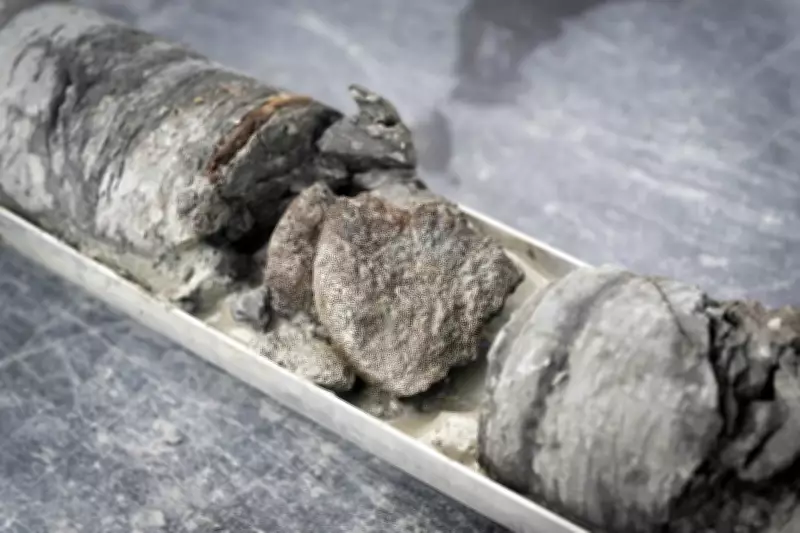
Imagine drilling into the Earth's core for a sustainable energy future and discovering an ancient artifact that transports you back in time to when our world was at its most primitive stage. This is precisely what occurred beneath the asphalt of the Denver Museum of Nature and Science in Colorado. Engineers had set up equipment in the north section of the museum's parking lot, intending to drill test boreholes to explore geothermal energy.
As the narrow drill bit ground its way hundreds of feet beneath the surface, it pulled up localized columns of underground rock to analyze the area's thermal properties. Suddenly, researchers supervising the operation noticed that the extracted geological cylinders contained more than just standard sand and gravel. One small sample, measuring two and a half inches in width, yielded an obvious dark biological structure. Further analysis revealed this to be the mother lode of urban paleontology. The drilling machine had unearthed a fossil of one bone from the spine of a dinosaur, making it the oldest dinosaur fossil yet found in any metropolitan city area.
Exploring the Hidden Geology of the Denver Basin
The find served as an invaluable gift for geologists, as it is highly unlikely to come across such a discovery while drilling through a narrow hole in rock. According to an advanced hydrogeological study released by the U.S. Geological Survey under the name Denver Basin Aquifer System, the strata beneath modern-day Denver are composed of millions of years' worth of sedimentary rock layers. By mapping the depth of the borehole, geologists determined that the drill bit had traveled an astonishing 763 feet below the parking lot before intersecting the fossil.

As described in a geological guide called Beyond Colorado's Front Range, issued by the U.S. Geological Survey, this particular depth represents untouched bedrock from the Late Cretaceous period. The surrounding rock matrix had distinctive signs of old swamps, with fossilized swamp vegetation, proving that this buried layer was a fertile floodplain dating to about 67.5 million years ago—just a little before the devastating asteroid impact ended the Mesozoic Era.
Bringing the Lost Prehistoric Wetland to Life
The small hockey puck-like object was removed from the sedimentary column, and vertebrate paleontologists classified it as a vertebral centrum, essentially a central vertebra from the skeleton of a dinosaur. From the size and structure of the bone, researchers concluded that the artifact came from a mid-sized herbivorous dinosaur, either Edmontosaurus or Thescelosaurus. However, since construction work destroyed the remainder of the buried skeleton, further classification is currently impossible.
Today, the unique fossil is proudly displayed inside the museum's public galleries, serving as a beautiful reminder that our modern, concrete-paved cities are anchored directly on top of ancient, forgotten worlds. While thousands of visitors drive across the parking lot each day, a hidden tropical ecosystem of prehistoric titans rests completely undisturbed right beneath their tires.
This proves that even the most revolutionary discoveries in science need not involve expensive journeys deep into the wilderness; sometimes, all it takes is curiosity about the world around us and some energy experimentation to find something from Earth's history. One must feel humble knowing that while engineers were drilling into the Earth to make it greener for future generations, they inadvertently drilled into the vertebra of an animal that roamed the tropical forests of Colorado millions of years ago.