

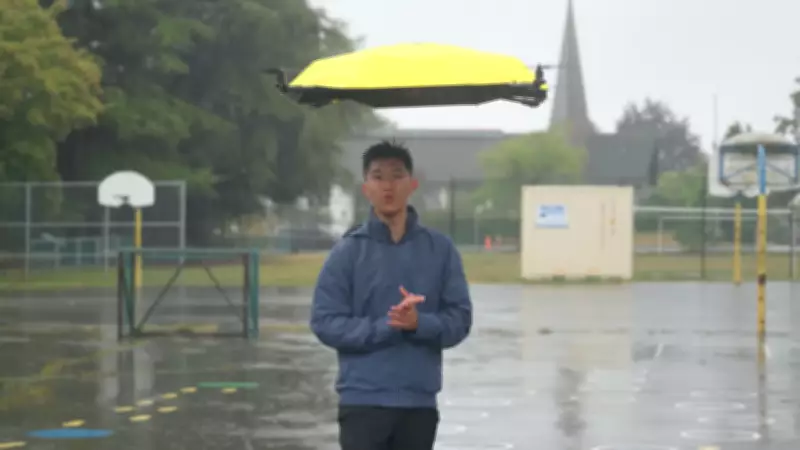
Canadian Engineer's Autonomous Flying Umbrella Captures Global Imagination
A Canadian inventor has created an internet sensation by developing a remarkable drone-powered flying umbrella that autonomously hovers above users and follows their movements without requiring manual handling. The innovative device, engineered by John Tse, appears deceptively ordinary at first glance but conceals sophisticated quadcopter drone technology beneath its conventional canopy.
The Vision Behind the Revolutionary Umbrella Design
John Tse, a Canada-based engineer, filmmaker, and creative maker renowned for his popular YouTube channel I Build Stuff, conceived this project as an ambitious DIY engineering experiment rather than a commercial product. His channel documents fascinating projects that blend robotics, software development, and accessible hardware components. The flying umbrella represents one of his most complex and evolving creations, having transformed over several years from an initial manually controlled prototype into a largely autonomous system designed to provide hands-free rain or sun protection.
How the Autonomous Flying Umbrella Operates
At its technological core, this extraordinary umbrella functions as a quadcopter drone cleverly concealed beneath a standard canopy structure. Four strategically positioned propellers generate the necessary lift and stability, while a lightweight internal framework constructed from 3D-printed components provides structural support. An onboard computer system continuously processes sensor data and communicates with the flight controller, enabling the umbrella to make real-time positional adjustments and maintain its centered position above the user.

Rather than depending solely on GPS technology, the system employs advanced depth-sensing and proximity detection mechanisms to identify and track the person beneath it. A sophisticated time-of-flight depth camera mounted underneath creates detailed three-dimensional positional mapping of the user. This innovative approach allows the umbrella to follow walking individuals while maintaining a safe vertical distance that keeps the rapidly spinning propellers well above head height for enhanced safety.
Evolution from Manual to Autonomous Operation
Earlier iterations of this project required manual remote control operation, which significantly limited practical utility. The latest version represents a substantial technological leap by operating completely autonomously, eliminating the need for constant steering or manual adjustments. Achieving this autonomous functionality required months of dedicated trial-and-error development, including meticulous flight stability tuning, vibration reduction engineering, and multiple software rewrites after numerous failed tracking attempts.
Despite its impressive engineering achievements, the flying umbrella remains fundamentally a prototype with certain limitations. Battery life currently restricts operation to approximately 10 to 15 minutes per charge, comparable to small consumer drones. Environmental factors like wind can affect stability, while heavy sideways rain reduces effective coverage. For essential safety considerations, the system is programmed to hover several metres above users to minimize potential risks.
Global Reactions and Technological Significance
Short video clips showcasing the umbrella's capabilities have spread rapidly across social media platforms including X, generating widespread admiration for its creative ingenuity alongside healthy skepticism about practical everyday applications. While some observers view it as a fascinating glimpse into future personal robotics, others consider it primarily an experimental novelty. The umbrella is not commercially available and isn't intended to replace conventional designs, but it powerfully demonstrates how contemporary DIY robotics and accessible consumer drone technology now enable individual creators to develop autonomous machines that were once exclusively confined to specialized research laboratories.






