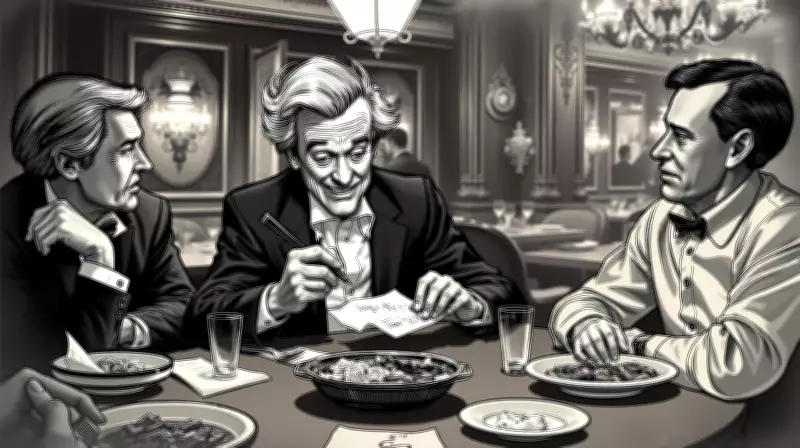
In the late 1970s, a casual lunch between friends led to one of physics' most peculiar unsolved puzzles. Nobel laureate Richard Feynman, dining with his friend Ralph Leighton at a Thai restaurant in Glendale, California, watched Leighton struggle over whether to order his favorite ginger chicken or try something new. Instead of offering advice, Feynman grabbed a sheet of paper and began scribbling equations, treating the dilemma as a formal mathematical optimization problem. He solved it on the spot, but his famously messy handwriting left the notes unreadable for decades. Nearly fifty years later, a team of researchers has finally deciphered Feynman's scrawled solution and confirmed something remarkable: his answer was mathematically correct all along.
How Richard Feynman's lunch order turned into a famous math mystery
Richard Feynman, who won the 1965 Nobel Prize in Physics for his work on quantum electrodynamics, was as well known for his playful approach to everyday problems as he was for his contributions to theoretical physics. During the late 1970s, he and Leighton, who would later co-author Feynman's bestselling memoir Surely You're Joking, Mr. Feynman!, were regulars at a Thai restaurant near Caltech, where Feynman taught. On one visit, Leighton found himself torn between ordering his usual ginger chicken or experimenting with a new dish from the menu, a decision Feynman immediately recognized as a textbook case of what mathematicians call an explore-exploit dilemma. According to a study published in the Proceedings of the National Academy of Sciences, Feynman responded by formalizing the problem and solving it mathematically before the meal was over.
What is the 'restaurant problem' that stumped researchers for 50 years
The puzzle Feynman sketched out belongs to a well-known family of mathematical questions called optimal stopping problems, the same logic used to model decisions like house-hunting or job-searching, where someone must decide when to stop searching and commit to an option. Feynman's version had a twist: unlike a house hunter who cannot go back to a property someone else has already bought, a diner can always return to a restaurant or dish they already know they like. That meant the goal was not simply to find the single best option, but to maximize total enjoyment across every meal during a stay, a subtly different and more complex mathematical challenge than the classic stopping problem most researchers were familiar with.

How scientists finally deciphered Feynman's handwritten equations
Feynman's notes survived in his personal archive, but his rushed, idiosyncratic handwriting made the underlying logic almost impossible to follow. Cognitive scientist Brian Christian of the University of Oxford, working with Evan Russek of Hunter College and Thomas Griffiths of Princeton University, spent months reconstructing exactly what problem Feynman had set out to solve before they could even begin checking his maths. The team enlisted help from Ralph Leighton himself and from Michael Gottlieb, who maintains the official Feynman Lectures website, to fill in gaps in the handwriting. Once reconstructed, the notes revealed that Feynman had derived a quality threshold, a benchmark used to decide, on any given night, whether a new dish was worth the risk compared with sticking to a known favorite.
Why Feynman's solution to the restaurant problem was mathematically optimal
After reconstructing the problem, the researchers proved that Feynman's original solution was indeed the mathematically optimal strategy for his version of the puzzle. They then extended his work, originally framed around choosing dishes at a single restaurant, into a broader model covering choices between many different restaurants, and tested it against several possible distributions of restaurant quality, including worlds where most options are mediocre with only a few standouts, and worlds where good restaurants are common. According to the PNAS paper, the team found closed-form mathematical solutions for these generalised versions too, extending a single physicist's lunchtime scribble into a broader theoretical framework nearly five decades later.

What real diners do compared with Feynman's ideal strategy
Beyond verifying Feynman's mathematics, the researchers also tested how ordinary people actually behave when faced with the same kind of choice. Participants in their experiments were asked to make a series of dining decisions, and their behaviour was compared against the optimal threshold strategy Feynman had derived. The results suggested that human decision-making is closer to mathematically rational than earlier psychological research had assumed, with participants' tendency to settle for 'good enough' options gradually shifting in a pattern that matched Feynman's declining threshold curve. The findings suggest that everyday intuition about when to stop exploring and stick with a favourite may be more sophisticated and more mathematically sound than scientists previously gave people credit for.