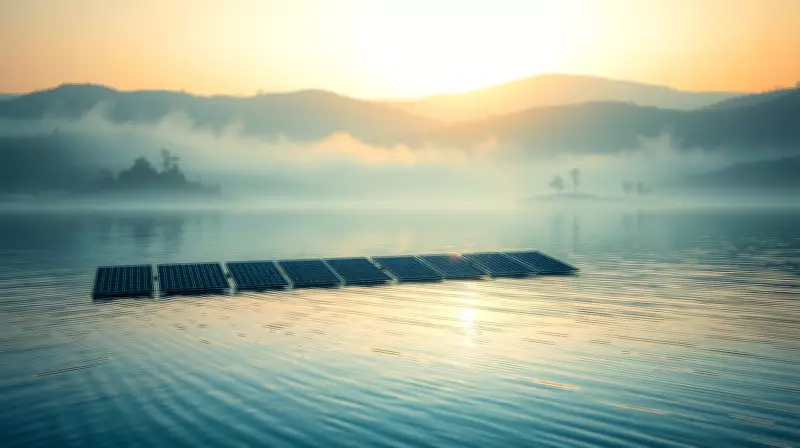
Solar farms need space. Lots of it. Build them on land, and you're competing with farms, forests, and wildlife. So Germany tried something different: putting solar panels on water. Specifically, on a flooded gravel pit in Bavaria, where an old industrial site had become just another abandoned scar on the landscape. The gamble was risky. Cover too much water with panels, and you shade the lake, change its temperature, kill oxygen levels, and wreck the ecosystem. But what actually happened surprised the sceptics. The panels only covered 4.65% of the lake surface. Light still reached the water. Life still thrived below. The system produced power without destroying what was underneath. For a world desperate for both clean energy and protected nature, this matters. It proves solar doesn't have to choose between generating electricity and leaving ecosystems intact.
Why lakes make better solar farms than fields
The problem is simple: where do you put millions of solar panels when land is already crowded with people, crops, and nature that needs protecting? Germany has 6,043 artificial lakes, gravel pits, quarry sites, reservoirs, and abandoned mining areas. Most sit there doing nothing but collecting rainwater and memories of extraction. They're industrial scars, already damaged landscapes. Using them for solar makes sense.
Floating photovoltaic systems, or FPV, place panels on rafts or floating structures on water instead of mounting them on rooftops or spreading them across fields. The concept is elegant. The water body already carries an industrial footprint. You're not creating new damage; you're repurposing existing damage. You're turning a place nobody wanted into a power source.

The Jais gravel pit in the Starnberg district sat abandoned until 2025, when it became something different. The installation is called the Jais Vertical Floating Photovoltaic System, the world's first of its kind. It has 1.87 megawatts of capacity. It's expected to produce about 2 gigawatt-hours of electricity annually. And it covers only 4.65% of the lake's surface. That percentage is everything.
Vertical panels: A different approach to catching sunlight
Most solar panels tilt at angles that optimise midday sun, the familiar setup on roofs and in solar farms. The Jais system works differently. The panels stand vertically, facing east and west. This catches sunlight in the morning and evening when homes and offices still need power, but traditional solar systems are weakening.
It's a timing problem that most people don't think about. Solar power peaks around midday, but that's not when electricity demand is highest throughout the day. Morning commutes and evening activity actually consume more power than the middle of the afternoon. Vertical bifacial panels that collect light from both sides capture light before and after noon, when tilted systems produce less.
The system uses about 2,600 of these vertical modules. They're anchored with a keel-like stabiliser reaching about 5.2 feet below the surface to handle wind and water level changes. The rows are separated by open water corridors at least 13 feet wide. This design matters because it's not just about making panels fit on water. It's about making sure water stays water beneath them.
The real question: Does the lake survive?
Every serious floating solar project faces one core challenge: shading. Cover too much water with panels, and you've essentially darkened a section of the lake. Darkness changes everything. Algae and underwater plants produce less energy. Oxygen levels drop. Temperature changes ripple through the food web. Fish behaviour shifts. Breeding water birds lose habitat. These aren't minor issues.

Germany's regulations are strict about this. Floating solar plants may generally be built only on artificial or heavily altered water bodies, and they must not cover more than 15% of the water surface or sit closer than about 131 feet from the shore. The Jais project sits far below that ceiling. Early observations from the site show that sunlight and oxygen exchange still occur at the water surface. Floating structures have been used for breeding water birds and fish. That's not guaranteed to happen at every installation, but this first case gives regulators something concrete. Research on floating photovoltaic impacts found that lake coverage with FPV results in reduced water temperatures and modified thermal stratification during summer, which could mitigate the effects of climate change, with the reduction of water temperatures following a non-linear relationship with increased FPV occupancy. That's unexpected. Colder water in an age of climate change isn't a bug; it's potentially a feature.
Money matters: The industrial side gets cheaper
During early operation, the gravel operation connected to the system cut its grid electricity use by about 60%. When production stabilises, savings are expected to reach 70%. For an industrial user constantly exposed to energy price swings, that's massive economic insulation. It's also why this works, practically the power is being used nearby, not feeding distant grids. That reduces pressure on transmission lines already struggling with Europe's renewable transition.
A second phase of 1.7 megawatts is already planned. Total coverage will stay below 10%. That's the key number: the lake remains a lake. It's not a power plant that used to be a lake. It's still water with light, oxygen, and life. The panels just float above it.
The bigger picture: Germany has room for thousands more
The really important finding is scale. Germany conducted an analysis showing 6,043 artificial water bodies at least 2.47 acres, exist across the country, covering more than 222,000 acres total. Around 70% of those are gravel pit mining scars waiting for second lives. If Germany used even a fraction of these for floating solar with the same 15% or less coverage rules, the potential capacity is enormous.
Researchers estimate Germany could install up to 2,500 megawatts of floating solar on artificial waters under current practical and ecological limits. That's real energy. It's not replacing coal or nuclear plants, but it's a meaningful contribution to clean power. And it's happening on land that's already been damaged, already had its natural state altered.
The rest of Europe is watching. Floating solar is moving beyond novelty status. It's becoming infrastructure. SolarPower Europe has published guidance on best practices, helping developers avoid poor environmental planning. The technology is becoming standardised.
What this proves about energy and nature
The Jais project proves something important: energy transition doesn't have to mean choosing between power and protection. You can generate clean electricity without destroying ecosystems if you're thoughtful about design. Vertical panels. Limited coverage. Careful site selection. Open water corridors. These aren't complications. They're the actual design.
The gravel pit in Bavaria tells you something about the future. Industrial sites can become power sources. Abandoned land can generate clean energy. Water bodies that nobody wanted can do useful work. That's not revolutionary technology. It's smart thinking about where things go and why.
About the Author
The TOI Science Desk stands as an inquisitive team of journalists, ceaselessly delving into the realms of discovery to curate a captivating collection of news, features, and articles from the vast and ever-evolving world of science for the readers of The Times of India. Consider us your scientific companion, delivering a daily dose of wonder and enlightenment. Whether it's the intricacies of genetic engineering, the marvels of space exploration, or the latest in artificial intelligence, the TOI Science Desk ensures you stay connected to the pulse of the scientific world. At the TOI Science Desk, we are not just reporters; we are storytellers of scientific narratives. We are committed to demystifying the intricacies of science, making it accessible and engaging for readers of all backgrounds. Join us as we craft knowledge with precision and passion, bringing you on a journey where the mysteries of the universe unfold with every word.