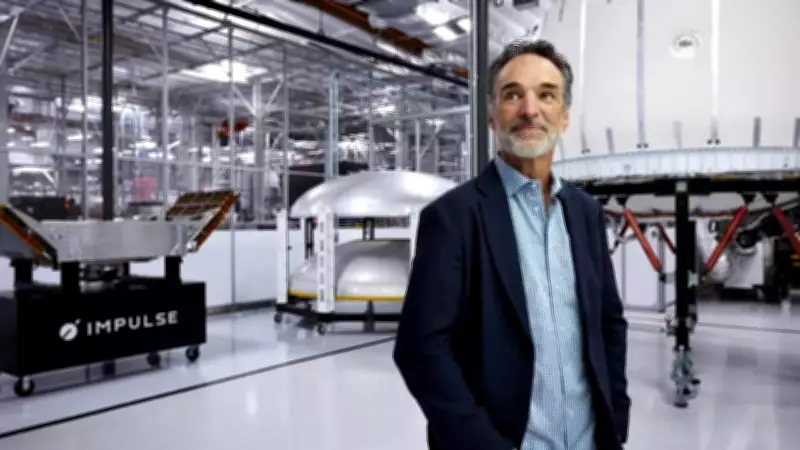
On a stretch of Los Angeles' South Bay where aerospace firms sit between logistics yards and sun-faded industrial units, Tom Mueller moves through traffic with a kind of impatient ease. He is talking about space as though it is already part of the road network, something that can be mapped, optimised, and rerouted. The conversation jumps between orbital mechanics and the limits of Earth's resources, with brief pauses for red lights and lane changes. There is a sense that he has not entirely left the engineering mindset he built during decades in propulsion work, only redirected it. Now the focus is on what happens after rockets finish their job, when payloads are left circling above the planet and still need somewhere to go.
How a Small Idaho Timber Town Shaped Tom Mueller's Future as a Rocket Propulsion Engineer
Mueller's career began far from the Los Angeles aerospace corridor, in a small timber town in Idaho, where machinery and repair work were part of everyday life. That early exposure to hands-on engineering carried through to university and eventually into the Los Angeles defence and aerospace sector in the 1980s. He worked on propulsion systems during a period when government funding kept experimental programmes alive, and engineers were given room to test ideas that would later be heavily restricted. Decisions moved slowly, shaped by layers of oversight that did not sit well with someone more interested in building than discussing. Outside work, he spent time with small experimental engineering groups in the desert, informal spaces where propulsion work could be tested without committees or formal reviews. He recalls, 'I worked on all kinds of crazy things.'
Inside the Shift from Launch Technology to Orbital Logistics
By the early 2000s, Mueller was working on high-thrust engine concepts in a warehouse in El Segundo when a young entrepreneur looking for rocket technology was introduced to him. The meeting led to a job offer and a rapid exit from his then-employer. At the new venture, he became central to the development of propulsion systems that would later power reusable orbital launch vehicles and spacecraft missions to the International Space Station. Engines were designed, tested, redesigned, and tested again, often under tight timelines and financial pressure. The work helped establish the reliability of systems that would go on to dominate commercial satellite launches. When he eventually left, the core problem of reaching orbit had largely been addressed. The question that followed was less about launch and more about movement once in space.

In 2021, the company he founded afterwards, Impulse Space, sits in a warehouse in Redondo Beach filled with test rigs, metal components and vacuum chambers. The ambition is not to build rockets that leave Earth, but vehicles that operate once satellites are already in orbit. The idea is simple in principle and complex in execution: satellites rarely reach their final positions directly and often spend months drifting into place using slow electric propulsion systems.
Mueller's argument is that this pace no longer matches the demands being placed on space infrastructure. Communications networks, defence systems and commercial constellations increasingly expect rapid repositioning. Impulse's approach relies on chemical propulsion systems designed to move spacecraft between orbits far faster than conventional electric systems allow. The trade-off is efficiency against speed, with the company prioritising time over fuel economy.
Inside the facility, production is deliberately integrated. Components that might normally be sourced from multiple suppliers are instead manufactured in-house. The reasoning is control rather than scale, with the belief that tighter production loops reduce delays and allow faster iteration between design and testing.

The Design Philosophy of Next-Generation Modular Spacecraft
The company's early spacecraft designs reflect different ends of the same idea. Impulse's in-house development effort has resulted in two primary spacecraft: Mira, designed for smaller missions in low Earth orbit, and Helios, built for heavy payload transport to higher orbital destinations. Mira, a compact craft roughly the size of a horse and resembling a toaster fitted with solar-panel wings, has already completed three successful missions. In contrast, Helios is a far larger vehicle described as similar to a futuristic water tank engineered to carry up to four tons of payload from low Earth orbit to geostationary orbit, a journey of more than 20,000 miles, in under 24 hours. Reportedly, its inaugural mission is scheduled for 2027.
Mira's first two missions, conducted in late 2023 and early 2025, proceeded flawlessly, achieving a record 150-kilometer orbital boost, successfully rendezvousing with another satellite, and deploying customer CubeSats into their designated orbital paths. However, during its third mission earlier this year, a technical glitch caused the spacecraft's star trackers to generate noisy data.
US Space Funding Surge Fueling Impulse's Growth
For now, Impulse's biggest demand driver is the US government, a pattern that is common across the space industry. The US Space Force has requested $71 billion for fiscal year 2027, a 77% increase over current levels, as the Pentagon adopts a more assertive approach to space operations, including President Trump's proposed $175 billion 'Golden Dome' missile-defense initiative. NASA, meanwhile, has outlined plans to establish a permanent lunar basecamp by the end of the decade. Impulse is positioning itself to benefit from this expanding pipeline of public-sector space spending.
Reportedly, so far, the company has secured nearly $400 million in contracts, the vast majority of which comes from government funding, according to Impulse president Eric Romo. Romo, who began his career as an MBA intern at SpaceX before going on to found and sell multiple companies and later work at Facebook, now leads Impulse as it scales alongside this surge in space-focused defense and exploration programs.