ISRO Chairman V Narayanan Details India's Ambitious Space Expansion Plans
In a landmark address at the Engineering Staff College of India, ISRO Chairman V Narayanan laid out a comprehensive and bold roadmap for India's space programme, highlighting a decisive expansion in launch capabilities, human spaceflight, and lunar exploration. Speaking to scientists from ISRO, DRDO, and the Aeronautical Society of India during the Prof Satish Dhawan memorial lecture, Narayanan emphasized that safety and institutional trust remain central to every mission, while outlining a series of groundbreaking initiatives set to propel India into a leading role in global space endeavors.
Key Milestones and Future Missions
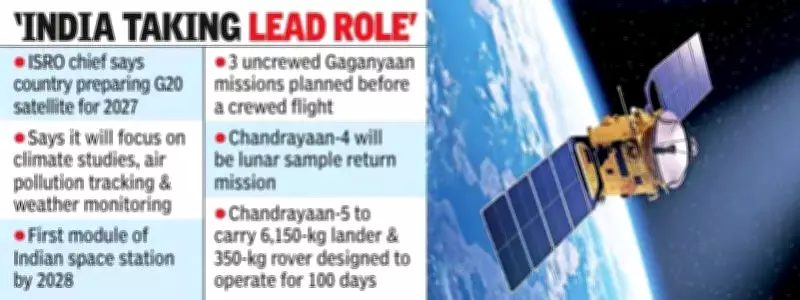
Narayanan announced several critical projects, including a G20 satellite scheduled for 2027, which will focus on climate studies, air pollution tracking, and weather monitoring. This mission underscores India's growing emphasis on trusted international cooperation and the practical applications of space technology. Additionally, the first module of the Bharatiya Antariksh Station, a 52-tonne space station planned in five modules, has received approval and is on track for completion by 2035.
On the human spaceflight front, the Gaganyaan programme will see three uncrewed missions beginning this year, followed by a crewed flight. Narayanan described this as a joint effort with DRDO, involving around 8,000 experiments already completed. For lunar exploration, Chandrayaan-4 is planned as a sample return mission, while Chandrayaan-5 will feature a 6,150-kg lander and a 350-kg rover designed to operate for approximately 100 days.

Long-Term Vision and Technological Advancements
Looking ahead, Narayanan declared that by 2040, an Indian will land on the moon, linking this ambitious goal to India's broader aspiration of becoming a developed nation. He also revealed plans for a Venus orbiter, a Mars lander, a next-generation launcher capable of placing 30,000 kg in low-Earth orbit, and a heavier future rocket to support the lunar landing mission.
Reflecting on ISRO's journey, Narayanan highlighted the agency's commitment to reliability and safety, citing the 1979 SLV-3 mission failure where former chairman Satish Dhawan publicly accepted responsibility, later allowing the team to receive credit after subsequent successes. He noted that every failure has strengthened mission assurance, institutional discipline, and readiness for more complex programmes.
Recent Achievements and Global Impact
Narayanan pointed to recent milestones, such as India's 100th launch vehicle mission on January 29 last year, a significant achievement following the initial unsuccessful mission in 1979. He also highlighted India's record of placing 104 satellites in orbit with a single rocket without collision and the launch of 433 satellites from 34 countries in commercial missions from Indian soil.
Among other accomplishments, he cited the successful docking experiment in 2025, making India the fourth country to demonstrate this capability, the launch of the NASA-ISRO Synthetic Aperture Radar satellite, and the December 24, 2025, commercial launch of the heaviest satellite ever lifted from Indian soil.