

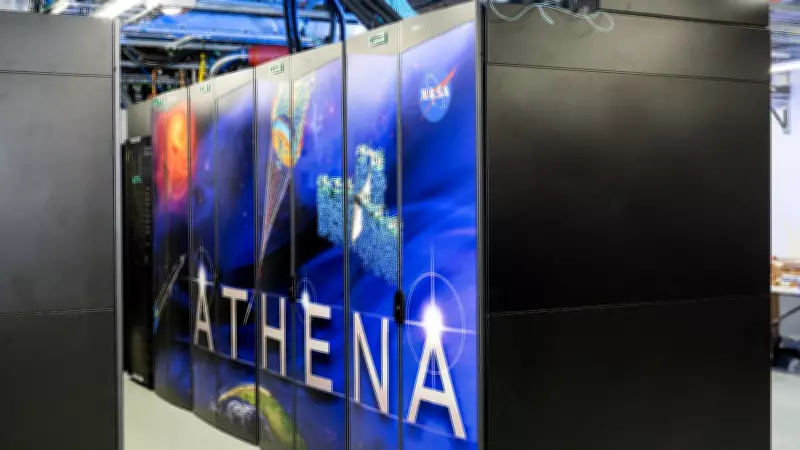
NASA's Athena Supercomputer: The Digital Powerhouse Behind Artemis II
As NASA prepares for the historic Artemis II mission, marking the first crewed lunar flight in over five decades, the space agency has unveiled a groundbreaking technological achievement that will be crucial to the mission's success. Introducing Athena, NASA's most powerful supercomputer to date, which represents a significant leap forward in handling complex scientific and engineering data essential for space exploration.
Athena's Impressive Technical Specifications
Named after the Greek goddess of wisdom and strategic warfare, Athena was selected through an internal NASA contest last year and became operational for all approved users on January 14, 2026. This supercomputer was launched through NASA's Advanced Supercomputing facility and boasts remarkable capabilities that set new standards for computational power.
The system consists of 1,024 computing nodes, with each node equipped with two 128-core AMD EPYC 'Turin' processors. This configuration provides 256 physical cores per node and an astonishing total of over 264,000 cores across the entire system. At peak performance, Athena can deliver more than 20 petaflops, meaning it can perform over 20 quadrillion calculations per second, making it NASA's fastest supercomputer ever.

Critical Role in Artemis II Mission Planning
Athena serves as the latest addition to NASA's High-End Computing Capability (HECC) family of systems, providing researchers with unprecedented access to high-performance computing resources. These resources are vital for numerous applications, including aerodynamic simulations, propulsion studies, and radiation modeling for astronaut safety.
As Artemis II approaches its launch window, Athena will play a pivotal role in mission planning and safety analysis. The supercomputer's immense processing power enables engineers to:
- Model spacecraft performance with unprecedented accuracy
- Analyze potential risks and develop mitigation strategies
- Refine mission details long before astronauts board the spacecraft bound for the Moon
Beyond the immediate needs of Artemis II, Athena will support research across multiple scientific domains, including Earth science, astrophysics, and aeronautics, ensuring its utility extends far beyond lunar missions.
Advanced Architecture and Infrastructure
Built by Hewlett Packard Enterprise, Athena utilizes four HPE Cray EX4000 racks and operates with the Tri-Lab Operating System Stack (TOSS). The system is enhanced by professional job scheduling software and various compilers, offering scientists flexibility in managing their computational workloads.
With nearly 800 terabytes of system memory, Athena can process exceptionally large and complex datasets that were previously challenging to handle. The supercomputer is housed in NASA's Modular Supercomputing Facility and surpasses earlier systems like Aitken and Pleiades in both speed and energy efficiency.
Powering the Future of Space Exploration
The deployment of Athena represents more than just a technological upgrade; it strengthens the digital backbone supporting NASA's ambitious exploration goals. With this supercomputer now online, NASA ensures that human missions to the Moon and eventual journeys to Mars are backed by the most powerful computing tools available.
As Artemis II progresses toward becoming the first crewed mission around the Moon since the Apollo era, Athena stands ready to provide the computational firepower needed to make this historic endeavor a success, while simultaneously advancing scientific research that will benefit future generations of space exploration.






