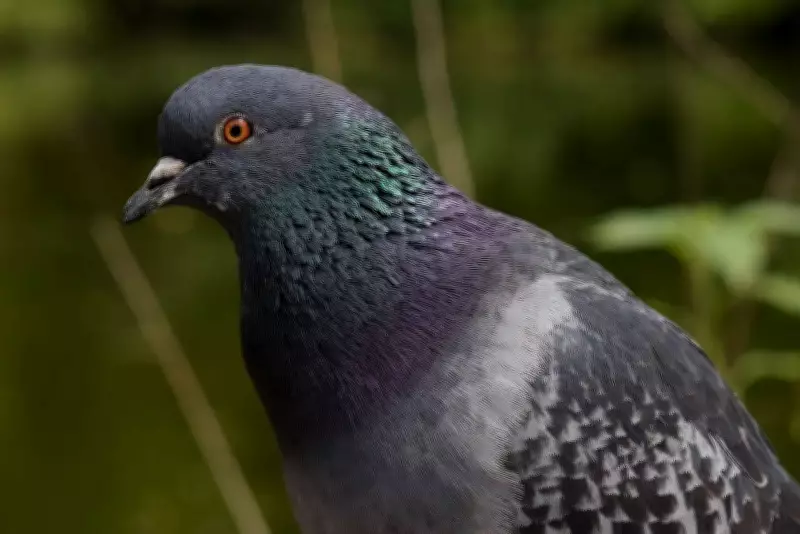
Pigeons are an inseparable part of city life, wandering across roads and streets with ease. Their constant head-bobbing while walking is a familiar sight, but a new study reveals that their vision changes dramatically once they take to the skies.
Study Reveals Eye-Locking Behavior in Flight
Research titled "Pigeons Lock Their Eyes in Place While Flying" has uncovered that when pigeons fly, they hold their gaze steady instead of scanning for dangers. Scientists achieved this by designing specialized tiny eye-tracking cameras mounted on pigeons' heads, similar to head-mounted cameras used in sports.
The Secret to Flying Straight
While pigeons bob their heads on the ground to stabilize their field of view, researchers assumed their eyes would be equally active in the air. However, the study found that after take-off, pigeons' pupils dilate to let in maximum light, and their eyes settle into a forward-facing position, locking in place.

This locking behavior simplifies the chaotic visual information during flight. By keeping eyes still relative to their skulls, pigeons rely on their balance and spatial perception. The retinal motion detected directly relates to body position, helping calculate optical flow—the rate at which scenery moves across their vision.
An Awful Blind Spot in Mid-Air
While this mechanism aids navigation, it creates a significant blind spot. Pigeons become oblivious to their left, right, and above, making them vulnerable to aerial predators like peregrine falcons and hawks. These raptors can dive from angles outside the pigeon's locked visual field, catching them unaware.
This trade-off prioritizes flight stability over constant scanning—a classic evolutionary compromise. In nature, survival often depends on constant caution, but pigeons sacrifice peripheral awareness for precise steering.
Implications for Biology and Technology
The study challenges textbook biology, which taught that most animals use a fixate-and-saccade system. Flight changes how pigeons use vision, and this observation could inspire drone navigation technology. Engineers struggle to design drones that navigate complex environments without collisions; studying pigeon vision may improve autonomous aerial vehicle software.
Next time you see pigeons scatter into the sky, remember they are not scanning like on the ground. Instead, they lock their gaze ahead, focusing entirely on their journey home.