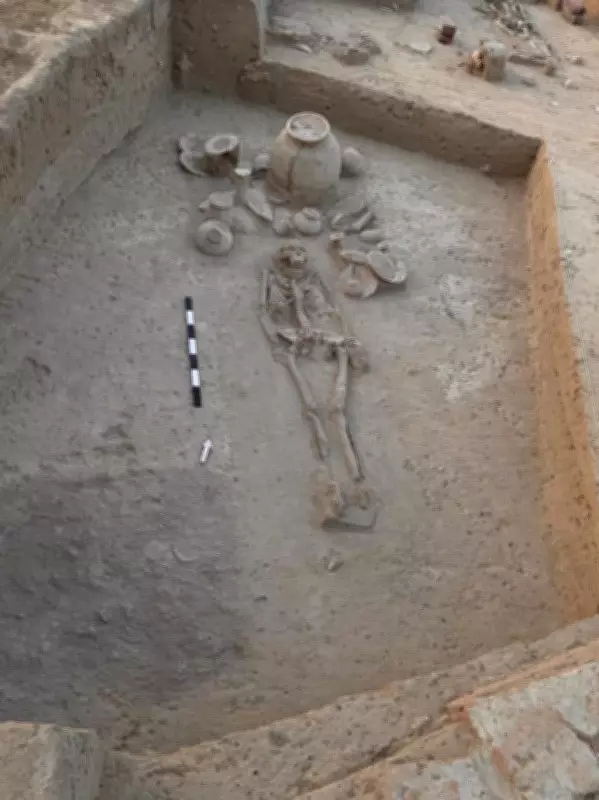
Eight Skeletons Discovered at Mound 7
Archaeologists from the Archaeological Survey of India (ASI) have unearthed eight human skeletons, including three women, at the Harappan site of Rakhigarhi in Haryana's Hisar district. The discovery was made during the latest excavation season at Mound 7, the cemetery area of the nearly 5,000-year-old settlement, considered the largest of the Indus Valley Civilisation. Alongside the skeletons, the team recovered pottery, ornamental offerings, gold ornaments, shell bangles, and habitation structures, providing fresh evidence of the social, cultural, and burial practices of the Harappan people.
Shell Bangles and Trade Networks
Two of the female skeletons were found wearing intact shell bangles on their wrists, offering rare insights into Harappan customs. ASI Superintending Archaeologist Manoj Saxena, who led the excavation, stated that the recovery of shell bangles reinforces the view that Rakhigarhi was a major administrative and trade hub. Previous excavations by archaeologist Prof Vasant Shinde of Deccan College, Pune, had uncovered ornaments made from carnelian, shells, lapis lazuli, jasper, and agate sourced from coastal regions and distant areas. The Harappans are known to have procured lapis lazuli from Afghanistan, colourful carnelian beads and shell bangles from coastal regions, and chert blades from Rohri in present-day Pakistan.
DNA Analysis and Scientific Studies
Three skeletons, including two women, have been sent to the Anthropological Survey of India (AnSI) in Kolkata for analysis, while samples from one skeleton have been sent to the Birbal Sahni Institute of Palaeosciences (BSIP), Lucknow, for DNA extraction. The findings are expected to provide a better understanding of the lives, lineage, and descendants of the people who lived at Rakhigarhi. DNA studies could help trace genetic profiles, diet, health, and lifestyle, and bridge gaps in understanding the period between the Harappan Civilisation and present-day populations.

Burial Offerings and Pottery
Archaeologists recovered around 40 pottery offerings placed with the bodies, indicating that the Harappans buried pottery and other objects along with the deceased. The excavation process was painstaking, with each bone and associated artefact removed layer by layer to avoid damage. Several skeletons were found in a fragile condition due to centuries of agricultural activity on the land.
Excavations Across Multiple Mounds
The latest excavation season, which began on February 22 under the supervision of ASI Director General Yudhvir Singh Rawat, covered Mounds 1, 2, 3, 5, and 7. At Mound 1, remnants of Harappan houses, walls, and floors were uncovered, offering evidence of a well-planned urban settlement. Mound 2 yielded pottery, hearths, and domestic materials, shedding light on daily life and food preparation, with structural remains suggesting it was an industrial and commercial centre. At Mound 3, grain remains and ash deposits were found, which could reveal details about agricultural practices. Mound 5, excavated for the first time, yielded residential structures, beads, pottery, and objects of daily use, indicating it was also a habitation area.
Government Initiatives and Tourism Potential
The Central government has designated Rakhigarhi as an 'iconic site' and proposed developing it as a "vibrant cultural destination" along with 14 other archaeological sites. An allocation of Rs 500 crore has been made for infrastructure development, including a world-class archaeological museum, a research institute, modern tourist facilities, and upgraded local infrastructure. Haryana Chief Minister Nayab Singh Saini recently stated that the government is actively pursuing UNESCO World Heritage List inclusion for Rakhigarhi. ASI's Manoj Saxena confirmed that the on-site museum has been completed, and artefacts will soon be displayed. Dinesh Sheoran, former sarpanch, noted that Rakhigarhi already attracts domestic and international tourists, and locals actively guide visitors.