Long before weather apps, satellite images and seasonal outlooks became commonplace, many farming communities relied on observations drawn from the landscape around them. Clouds, winds, insects, flowering plants and birds all formed part of a practical system of reading environmental change.
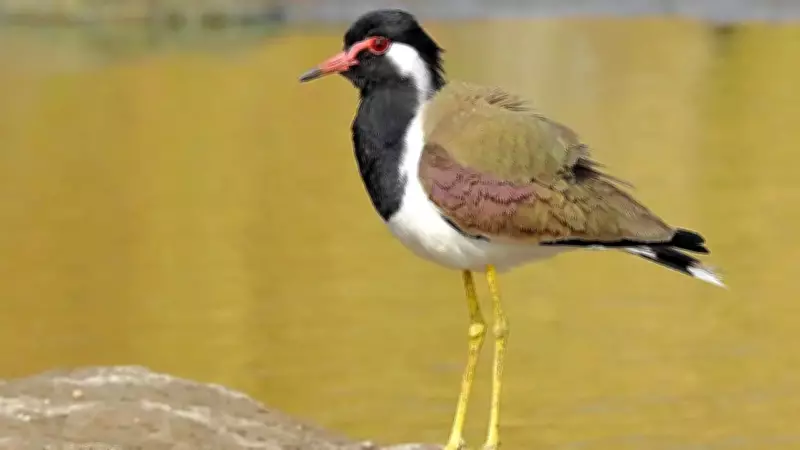
Among these traditional indicators, one bird occupies a distinctive place in parts of western India. The red-wattled lapwing, a noisy ground-nesting bird often seen near fields and wetlands, has for generations been treated as a natural signal of the approaching monsoon. Farmers have watched where it nests, how it arranges its eggs and even the materials used in its nest. These observations were not merely folklore. They often influenced decisions about sowing, crop selection and water management before the rains arrived.
A recent scientific study has examined these long-held beliefs in detail, offering a rare look at how traditional weather knowledge continues to shape farming practices today.

Why the Red-Wattled Lapwing is Known as the 'Monsoon Forecaster'
The red-wattled lapwing is widely distributed across the Indian subcontinent. Recognisable by its striking red facial wattles and loud alarm calls, it frequently nests in open fields, dry ground and areas close to human settlements. According to the research published in the American Meteorological Society, titled “Red-Wattled Lapwing (Vanellus indicus): A Traditional Rain Forecaster for Tribal Farmers of Southwestern Rajasthan”, researchers spent eight years documenting how tribal farmers in southwestern Rajasthan interpret the bird's behaviour as a predictor of rainfall. The investigation involved 200 farmers, alongside ornithologists, agricultural scientists and field observations of lapwing nests.
According to the study, the older tribal farmers have an assortment of knowledge about the behaviour of red-wattled lapwing as rain prediction indicators, such as nesting sites, egg position, egg arrangement, nesting material, numbers of eggs, and egg-laying patterns. The researchers added that these traditional observations showed a direct correlation with modern meteorological observations.
For many communities, the bird is far more than a familiar sight. It serves as a seasonal guide whose nesting choices are believed to reveal what lies ahead during the monsoon months.
How Red-Wattled Lapwing Nests and Eggs Help Farmers Predict Rainfall
The most important clues, according to farmers interviewed in the study, come from where the bird chooses to build its nest.
- A nest located on elevated ground is traditionally interpreted as a sign that substantial rainfall may arrive later in the season.
- By contrast, nests built in dry streambeds or low-lying areas are often viewed as warnings of weak rainfall or drought conditions.
Egg placement is watched just as carefully. Farmers believe that vertically positioned eggs indicate stronger or longer-lasting rainfall, while eggs lying more horizontally point towards limited precipitation. The arrangement of the eggs also attracts attention. Eggs clustered closely together are commonly associated with a favourable rainy season, whereas widely scattered eggs are thought to signal patchier rainfall.
The researchers found that many of these observations matched rainfall patterns recorded during their field investigations. They noted several instances where nesting locations and egg positions appeared to correspond with subsequent weather conditions observed during the monsoon period.
Why the Red-Wattled Lapwing Still Matters to Farmers in Rajasthan
As per the study published in the American Meteorological Society, the tribal regions of Rajasthan are where farming remains highly dependent on rainfall. In such areas, access to modern weather forecasts can be inconsistent, particularly where network connectivity is limited.
For older farmers, lapwing behaviour remains part of everyday agricultural planning. Decisions about crop choice, seed investment, water conservation and field selection are often influenced by the birds' nesting patterns.

One of the study's observations was that traditional knowledge is unevenly distributed across generations. Farmers aged between 50 and 70 generally possessed far greater familiarity with lapwing indicators than younger farmers, many of whom relied primarily on meteorological forecasts.
The authors observed that valuable local knowledge is gradually disappearing. As traditional practices are passed down less frequently, younger generations are becoming less aware of the signs that earlier farmers routinely used when preparing for the monsoon.
Can Red-Wattled Lapwing Rainfall Predictions Complement Modern Weather Forecasts?
The researchers were careful not to suggest that bird behaviour should replace scientific forecasting. Instead, they argued that both systems may have something to offer.
Their findings showed that rainfall forecasts based on lapwing observations often corresponded closely with meteorological measurements recorded during the eight-year study period. While modern forecasting provides regional-scale information, traditional observations can offer highly local insights rooted in long-term experience.
As the authors wrote, "Rain forecasting can be improved by blending modern meteorological information with traditional proven indications." They also concluded that farmers who combine traditional knowledge with modern forecasts are often better equipped to make agricultural decisions.
The red-wattled lapwing may not appear in official weather bulletins, yet its role in rural communities reflects a broader reality. Across many parts of the world, environmental knowledge accumulated over generations still influences how people interpret changing seasons. For countless farmers in Rajasthan, the arrival of the monsoon is not judged solely by meteorological models. Sometimes, it begins with watching where a lapwing chooses to lay its eggs.