Swiss Researchers Pioneer Sustainable Gold Recovery from Electronic Waste
The precious yellow metal gold has been experiencing a remarkable surge in value over the past year, reaching unprecedented price levels that have shattered previous market records. As one of the world's most trusted and valuable commodities, gold continues to influence global markets and economies while serving as a symbol of stability, security, and status across generations.
The Hidden Treasure in Our Electronic Junk
Now consider this surprising reality: while gold maintains its traditional allure, vast quantities of this precious metal are being discarded in landfills worldwide through electronic waste. According to United Nations estimates, over 60 million tons of e-waste accumulate annually, with most ending up shredded, burned, or buried. This represents a significant waste of valuable resources, particularly gold that could be recovered and reused in new technologies.
What if a simple kitchen byproduct could unlock this hidden gold without relying on toxic chemicals or consuming massive amounts of energy? Researchers in Switzerland have discovered precisely such a solution, developing an innovative method that uses whey—a cheese production byproduct—to extract pure gold from scrapped computer components.

The Science Behind Gold Extraction from Cheese Waste
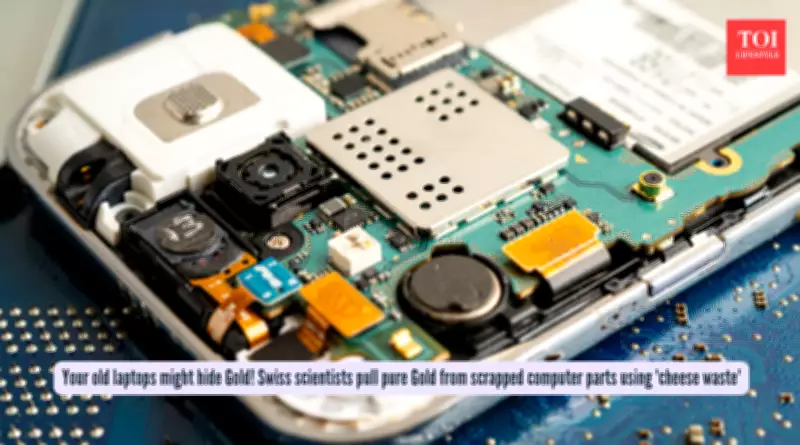
Most people discard old electronics like computer motherboards without realizing that each board contains approximately 450 milligrams of 22-carat gold. These components feature thin gold pathways mixed with copper and other metals, all embedded within layers of plastic and fiberglass. Traditional recycling methods typically involve shredding everything and applying intense heat or harsh chemicals, processes that consume substantial energy and generate problematic waste.
Scientists at ETH Zurich, led by Professor Raffaele Mezzenga, sought a more environmentally friendly approach. Their research, detailed in a 2024 Advanced Materials paper, demonstrates how whey proteins can serve as powerful tools for metal recovery. The team collected discarded motherboards destined for landfills and turned to whey, an inexpensive byproduct that dairy producers typically treat as low-value waste material.
How the Protein Sponge Technology Works
The researchers developed a sophisticated process beginning with heating whey proteins in acid to form microscopic amyloid fibrils. These fibrils naturally clump together to create a gel-like substance that, when dried, transforms into a porous "protein sponge" with an enormous surface area capable of capturing metal ions.
In practical tests involving 20 old motherboards, the team dissolved the metal components in acid before immersing the protein sponge in the solution. Remarkably, the sponge demonstrated selective affinity for gold ions, preferentially latching onto them while ignoring iron, aluminum, and copper ions present in the mixture.
The final step involves heating the gold-loaded sponge, which reduces the captured ions into metallic particles. These particles can then be melted together to create a solid gold nugget. In their experiments, researchers produced a 450-milligram nugget consisting of 91% pure 22-carat gold with 9% copper content.
Economic and Environmental Implications
Professor Mezzenga expressed particular enthusiasm about the sustainable nature of their discovery, stating, "The thing I like the most is that we're using a food industry byproduct to obtain gold from electronic waste." This approach represents a circular economy solution that addresses two waste streams simultaneously: cheese production byproducts and electronic waste.
The economic potential is equally compelling. The value of recovered gold exceeds the cost of whey by approximately fifty times, making this method financially viable while offering significant environmental benefits compared to conventional e-waste processing techniques.
This breakthrough technology demonstrates how innovative scientific approaches can transform waste materials into valuable resources, potentially revolutionizing how we manage electronic waste while recovering precious metals in an environmentally responsible manner.