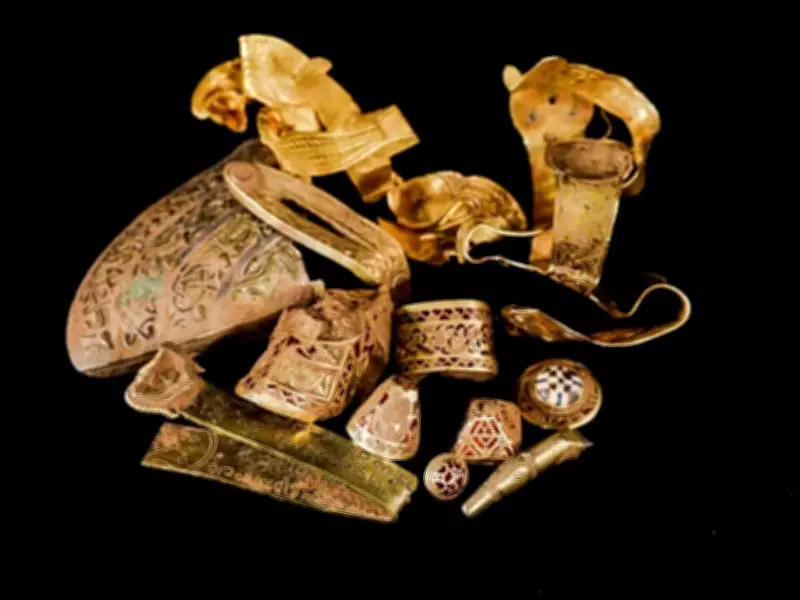
Some days feel ordinary, but July 2009 was not one of them for Terry Herbert. Unemployed and armed with a cheap metal detector, he gained permission to search a farmer's field in Staffordshire, England. What began as a routine outing, typically yielding a few old coins and a sore back, turned into the largest Anglo-Saxon archaeological find in history.
The Find That Came Out of Nowhere
Herbert was walking across a field owned by farmer Fred Johnson, near Lichfield, when his detector signaled gold. Not a penny or a brooch, but gold. Then more gold, followed by silver and chunks of something extraordinary. He kept walking and kept finding artifacts. When archaeologists formally assessed the site, the field had yielded approximately 4,600 pieces of 7th-century Anglo-Saxon gold and silver—the largest hoard of its kind ever found anywhere on Earth. They named it the Staffordshire Hoard. It was not just big; it was world-changing.
What Exactly Was in It?
This is where the discovery becomes intriguing and somewhat eerie. The hoard did not consist of coins or jewelry. Most items were fittings and fragments torn from weapons and military gear: sword grips, helmet bits, and high-status martial ornaments decorated with garnets, worked in gold with a level of craftsmanship breathtaking even by modern standards. The strange part is that many pieces had been intentionally broken before burial. They were not damaged over centuries underground; someone had stripped them apart, removed them from swords, separated them, crushed some parts, and placed the whole collection in one cache.

This detail transforms the Staffordshire Hoard from a simple treasure find into a historical puzzle. Was it war loot? Tribute? Recycled wealth stripped from defeated enemies? The find suggests that Anglo-Saxon elites did not just accumulate wealth; they broke it apart, moved it around, and buried it in ways we still do not fully understand. According to The Guardian, the find changes our perceptions of Anglo-Saxon England. More than fifteen years later, scholars continue to debate the exact story behind this particular cache.
Why Is This Important for Our Understanding of Early History?
For American audiences raised on pop-culture versions of medieval Europe—castles, knights, and Crusades—the early medieval period often feels like a historical dead zone: a dark, vague gap between the fall of Rome and the 'real' Middle Ages, filled with people we know almost nothing about. The Staffordshire Hoard has shattered that idea. It provides evidence of an Anglo-Saxon world of amazing craftsmanship, accumulated wealth, and intricate power structures. These were not primitive villagers scraping along. The people who commissioned and made these objects lived in a sophisticated culture of status, warfare, and craft, in 7th-century England, long before the Norman Conquest taught in history classes.
The Story's Staying Power
What makes this discovery so enduring and shareable is the sheer improbability of its origin: one individual, a meadow, a cheap metal detector. A man who was out of work and decided to spend an afternoon doing something he liked. That origin story carries a quality rarely found in big institutional excavations. It is accidental—the historical equivalent of finding a Picasso at a garage sale, except the Picasso is 1,400 years old and there are 4,600 of them. There is something deeply moving about the hoard's meaning as well. These broken gold bits lay in the ground for over a thousand years. Above them, kingdoms rose and fell, languages evolved, and the whole modern world happened. Then one afternoon in July, a man with a metal detector wandered by, and the ground finally gave them up.