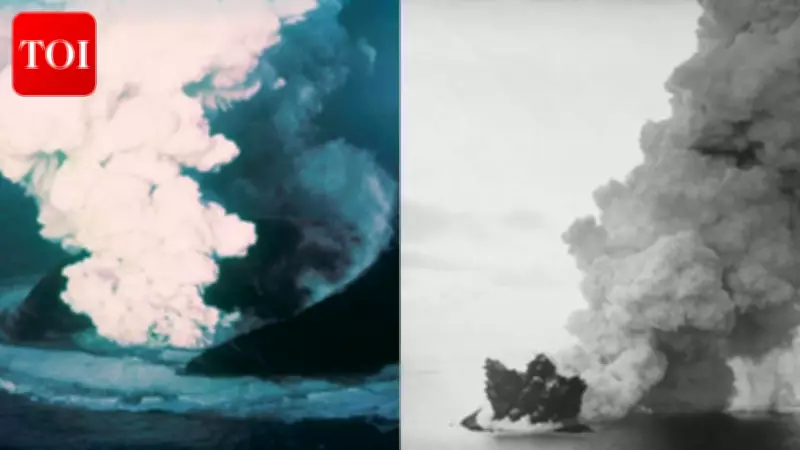
On a cold November morning in 1963, fishermen sailing off Iceland's southern coast noticed something unusual. Dark smoke was rising from the sea. At first, it looked like a ship on fire. Then the ocean began to erupt.
For days, ash, steam and molten rock burst through the waves as a powerful underwater volcanic eruption built an entirely new island where none had existed before. The newborn landmass was eventually named Surtsey, after Surtr, the fire giant of Norse mythology.
Most new islands are quickly altered by people, whether through tourism, development or scientific disturbance. Surtsey was different. Almost immediately after its birth, Iceland made a bold decision: keep humans out.

More than six decades later, that decision has transformed Surtsey into one of the most valuable scientific sites on Earth. Protected from nearly all human interference, the volcanic island has become a rare window into one of nature's most fundamental processes: how life begins on brand-new land.
A front-row seat to the birth of Surtsey volcanic island: One of nature's finest experiments
As per a research titled 'Internal structure of the volcanic island of Surtsey and surroundings: Constraints from a dense aeromagnetic survey,' by the University of Iceland, when Surtsey first emerged from the North Atlantic, it was a harsh and seemingly lifeless place. The landscape consisted almost entirely of black volcanic rock, loose ash and cooling lava. There was no soil, no freshwater and no vegetation.
Powerful winds battered the island, while salty ocean spray coated every surface. To most observers, it looked inhospitable.
To scientists, however, it represented a once-in-a-lifetime opportunity. For perhaps the first time in modern history, researchers could watch an ecosystem develop from the very beginning. Because the island's formation had been observed from its first moments, scientists had a unique starting point from which to study the arrival of life.
How plants, birds and insects slowly conquered the island
As per research supported by the Ministry of Science, Innovation and Universities project, the first arrivals were microscopic. Spores, bacteria and fungi carried by wind and ocean currents began reaching the island within months of its formation. Seeds followed, transported by waves, storms and seabirds travelling between Iceland and the surrounding ocean.
Many failed to survive. Some succeeded. Over time, patches of vegetation started appearing across the barren landscape. Mosses and hardy coastal plants established themselves among the volcanic rocks, gradually helping to create soil.
The island's transformation accelerated when seabirds began nesting there. Their droppings enriched the nutrient-poor ground, creating conditions that allowed more plants to take root.
As vegetation spread, insects arrived. Then came more bird species. What had once been a sterile pile of volcanic rock slowly developed into a functioning ecosystem.
Scientists have documented dozens of plant species, numerous insects and thriving seabird colonies, all establishing themselves without deliberate human assistance.
Why Surtsey is unlike any other place on Earth
Many islands provide clues about how ecosystems evolve. Surtsey offers something far rarer: a chance to observe the process from the very beginning.
Access to the island remains strictly controlled. Only authorised researchers are allowed to visit, and even they follow stringent rules designed to minimise contamination. The goal is simple: allow nature to write its own story.
According to UNESCO, which designated Surtsey a World Heritage Site in 2008, the island provides an outstanding natural laboratory for studying colonisation processes and ecological succession.
Few places on Earth offer such a clear record of how life establishes itself on entirely new land.
The island has become especially valuable for understanding how ecosystems recover after volcanic eruptions, landslides and other major environmental disturbances.

A glimpse into Earth's distant past
Perhaps the most fascinating aspect of Surtsey is what it represents. Billions of years ago, life on Earth faced similar challenges. New landscapes emerged from volcanic activity, glaciers retreated, and coastlines shifted. Organisms were forced to colonise fresh environments and build ecosystems from scratch.
Surtsey provides a modern-day version of that ancient story. Every plant that takes root, every bird that nests and every insect that arrives adds another chapter to an experiment that began with an eruption beneath the sea.
More than 60 years after it first rose from the North Atlantic, the island continues to evolve. Scientists still do not know exactly what it will look like a century from now.
What they do know is that Surtsey remains one of the closest things we have to a time machine, a place where the first steps of an ecosystem can be observed almost exactly as nature intended.