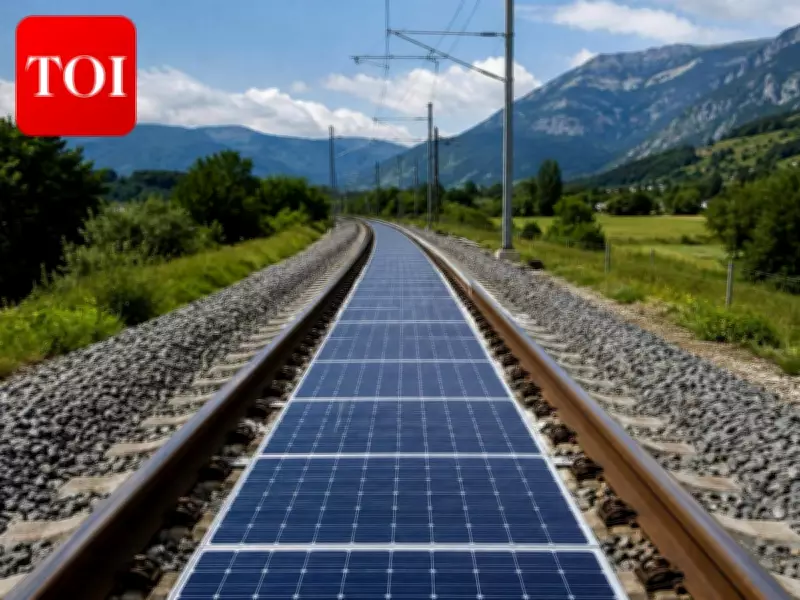
Trains pass through the small Swiss village of Buttes many times a day. For passengers, it appears nothing out of the ordinary, but the tracks beneath them are part of an experiment that could test a new way to use railway space for renewable energy. In western Switzerland, solar panels have been installed between the rails on an operating railway line, allowing trains to pass over them normally. The installation is very small, around 100 meters of track, but the technology has implications for many countries. It addresses the question of finding space for additional solar power generation, which is seen as one of the biggest hurdles in the expansion of renewable energy infrastructure. According to the French national railway company SNCF, it is the world's first removable solar power plant on a working railway line.
A Solar Experiment Beneath Moving Trains
The pilot project was launched on the 24th of April 2025 in Buttes, located in the canton of Neuchâtel, Switzerland. Swiss startup Sun-Ways has installed 48 photovoltaic panels between the tracks of Line 221, operated by regional railway company TransN. According to SNCF and Sun-Ways, the pilot has 48 panels with 18 kWp of capacity and an expected annual output of about 16,000 kWh. This amount is a very small part of Switzerland's overall electricity demand; the point of the project is to determine whether the solar panels can withstand three years of vibration, weather exposure, dust accumulation, and train traffic.
Why Railway Lines Have Become an Unexpected Solar Opportunity
Across Europe, there is a need for increased renewable energy, and many projects often encounter obstacles. A large solar farm may require agricultural land to be repurposed, a landscape to be changed, or it could potentially affect a local ecosystem. Railway lines, on the other hand, already exist; the corridors already run for thousands of kilometers, and they are already connected to electricity networks. SNCF has also shown strong interest in the pilot project in Switzerland and is monitoring it closely with its innovation division and SNCF Réseau, the railway infrastructure manager in France, to assess whether the system can be adapted for use across Europe in the future. Sun-Ways estimates that if all of Switzerland's suitable rail networks were covered with solar panels, they could generate up to 1 terawatt-hour of energy per year, representing about 2 percent of Switzerland's annual electricity usage. This figure comes from the company itself as an estimate, not an independently verified figure for the nation.

The Problem Is as Big as the Opportunity
Although the idea sounds simplistic, the installation of any technology on an active railway line faces many challenges. Apart from vibration, there is dust from braking wheels, airborne debris, weather conditions, and the fact that any apparatus attached to the track needs to be kept clear of the rails to allow routine track maintenance. The project faced initial objections relating to safety, maintenance, and durability before receiving approval. According to reporting on the project, Sun-Ways stated they had to supply numerous detailed technical reports and studies, as well as further safety analysis, before approval was given for the live installation. The solution applied for these problems is a removable system where the solar panels can be quickly removed for maintenance purposes. Anti-glare measures were also introduced to ensure the panels will not blind the drivers passing above.

Three Years of Data Could Decide the Future of the Technology
The system will run for three years until April 2028, by which time the project is expected to provide data on electricity generation, dust accumulation, maintenance costs, and the condition of the solar panels over the period. Engineers will also monitor how it fares in live operating conditions. SNCF believes that the results of the pilot scheme in Switzerland will provide valuable data that can then be used to ascertain if the technology is suitable for full implementation on rail networks. This means the small installation in Switzerland could help show whether similar railway solar projects are practical elsewhere by proving whether an installation between rails works over a sustained period. Worldwide, governments search for methods to produce renewable energy while avoiding the use of extra land. Examples include solar canopies over parking lots, floating solar installations on reservoirs, and solar projects integrated with highway infrastructure. Switzerland's railroad plan fits right into this. Instead of creating separate new energy spots, the project tries to get more value from existing infrastructure.