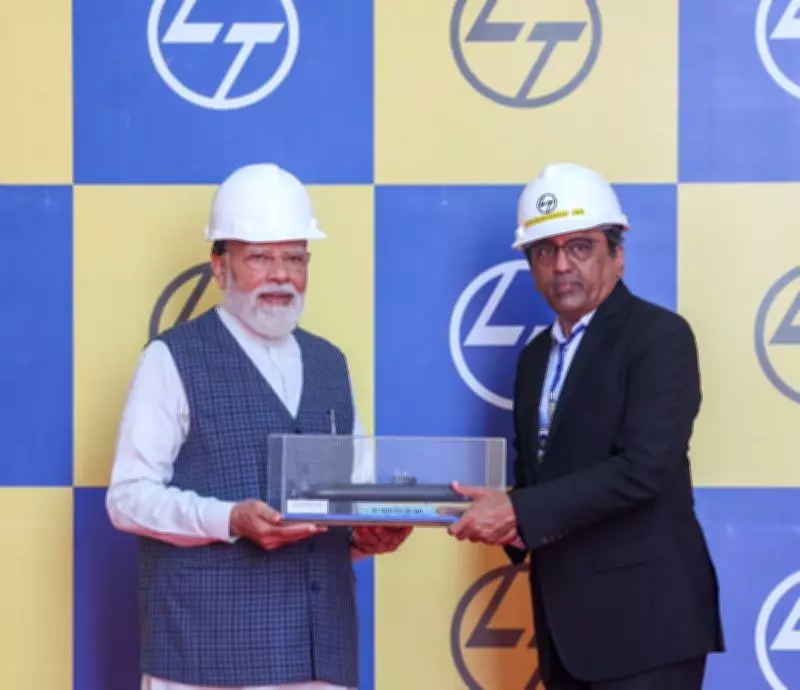
Prime Minister Narendra Modi's visit to Larsen & Toubro's (L&T) facility at Hazira, Gujarat, has brought significant attention to India's ambitious submarine program, known as Project 76. During the visit, L&T chairman and managing director SN Subrahmanyan presented a scaled-down model of the upcoming submarine to the PM, marking a pivotal moment for the nation's undersea warfare ambitions.
India's Submarine Structure
India's submarine force is organized under four key projects: Project 75, Project 75-I, Project 76, and Project 77. Project 75, which includes six Kalvari-class submarines built in collaboration with France's Naval Group, has been completed. Project 75-I, soon to be signed, will involve the construction of six next-generation submarines with German firm ThyssenKrupp Marine Systems (TKMS). Project 77 covers indigenous nuclear-powered submarines, known as SSNs. These projects are part of India's target to operate a fleet of 24 submarines for credible deterrence. Currently, the Navy operates 16 conventional submarines, with the six Kalvari-class vessels being the newest; the others are over 30 years old.
Project 76: Indigenous Design and Technology
As PM Modi posted a picture of receiving the submarine model, industry insiders quickly identified distinct design lines indicating a conventionally powered diesel-electric attack submarine equipped with air independent propulsion (AIP) technology. AIP allows a vessel to remain submerged for extended periods, significantly enhancing its stealth and operational capability. The detailed design of Project 76 is expected to be completed within the current fiscal year. For decades, India has relied on foreign original equipment manufacturers (OEMs) for conventional submarine designs, such as the French for the Kalvari class, the Germans for the next generation, and the Russians for the Kilo class of the 1980s.

Indigenization Goals
Under Project 76, the Navy aims for an initial indigenization rate of approximately 75 percent, which is expected to eventually scale up beyond 90 percent. All critical components, including sonars, communication suites, periscopes, weapon control systems, and structural steel, are intended to be entirely homegrown. This marks a significant shift towards self-reliance in defense manufacturing.
Advanced Propulsion and Energy Systems
While current AIP modules are scheduled to be retrofitted onto the Kalvari-class submarines, the AIP system for Project 76 vessels will have greater output to support a larger hull. Additionally, Project 76 is designed to utilize high-end indigenous lithium-ion battery banks, dramatically boosting underwater sprint speeds and energy retention. This technology will provide a substantial advantage in underwater performance compared to older submarine classes.
L&T's Role in Submarine Development
L&T has been a key player in India's submarine development for over three decades. The company has been part of the Advanced Technology Vessel (ATV) project, which delivered three Arihant-class nuclear-powered ballistic missile submarines (SSBNs), with a fourth one set to be commissioned. This experience positions L&T as a crucial partner in the execution of Project 76, leveraging its expertise in complex naval engineering and manufacturing.