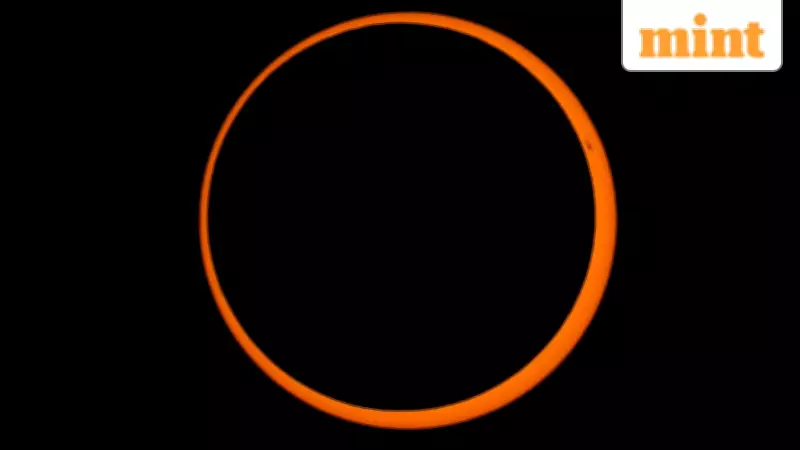
2026 Annular Solar Eclipse: A Celestial 'Ring of Fire' Event
The first solar eclipse of 2026 promises to be a spectacular astronomical display, featuring the mesmerizing 'ring of fire' phenomenon. This annular solar eclipse is scheduled for Tuesday, February 17, 2026, offering a rare glimpse of one of nature's most captivating celestial events.
Understanding the Annular Solar Eclipse
During an annular solar eclipse, the moon positions itself between Earth and the sun, but unlike a total eclipse, it doesn't completely cover the solar disc. Instead, the moon masks most of the sun's surface, leaving a brilliant, thin ring of sunlight visible around its edges. This distinctive appearance has earned it the popular nickname 'ring of fire' eclipse.
The term 'annular' itself originates from the Latin word 'annulus,' meaning ring, perfectly describing the visual phenomenon observers witness during this type of eclipse.

Visibility: Will India See the 'Ring of Fire'?
Unfortunately, the 2026 annular solar eclipse will not be visible from India. The celestial event will primarily be observable from remote southern regions, including:
- The southern edge of South America
- Southern Africa
- The Pacific, Atlantic, and Indian Oceans
- Most of Antarctica
The path of annularity—where observers can see the complete 'ring of fire' effect—will traverse distant sections of Antarctica and the southern reaches of the Southern Ocean. This limited visibility area means only year-round scientific research stations in Antarctica will witness the full annular eclipse.
Key Observing Locations and Timing
Primary viewing locations for the complete annular eclipse include Antarctic research stations such as the French-Italian Concordia Research Station and Russia's Mirny Station in Queen Mary Land on the continent's eastern side. The main American installation, McMurdo Station, will experience a significant partial eclipse with approximately 86% of the sun obscured by the moon.
Eclipse Timing (Coordinated Universal Time):
- Partial eclipse begins: 9:56 UTC
- Maximum eclipse: 12:12 UTC
- Partial eclipse ends: 14:27 UTC
Essential Safety Precautions
An annular eclipse is fundamentally a partial eclipse, meaning proper eye protection is absolutely essential for any observation attempt. It is never safe to view any solar eclipse without appropriate protective equipment. Specialized solar viewing glasses or indirect viewing methods must be employed throughout the event to prevent permanent eye damage.
The Science Behind the Spectacle
Astronomers classify this as an annular eclipse because the moon will be at a distant point in its orbit, making it appear slightly smaller than the sun from Earth's perspective. This orbital positioning prevents complete solar coverage, creating the characteristic ring effect at mid-eclipse when the sun's outer surface forms a luminous circle around the moon.
While not as dramatic as a total solar eclipse, annular eclipses offer their own unique fascination. As partial phases intensify, the sky noticeably dims, and natural pinhole projections create tiny crescent suns on surfaces below trees. However, unlike total eclipses, the sky never becomes completely dark during annular events, and stars and planets remain invisible. The sun itself becomes the captivating centerpiece of the celestial show.
This 2026 annular solar eclipse serves as a reminder of our solar system's intricate celestial mechanics and the awe-inspiring astronomical events that occur beyond our daily awareness. While Indian observers won't witness this particular 'ring of fire,' the event highlights the global nature of celestial phenomena and the importance of proper astronomical observation practices.