Punjab Overlooked in Central Livestock and Fisheries Funding, Infrastructure Lags
A recent report from the Parliamentary Standing Committee on Agriculture, Animal Husbandry and Food Processing has highlighted significant exclusions of Punjab from several crucial central government livestock and fisheries schemes. The findings point to serious gaps in fund allocation, veterinary infrastructure, and implementation, raising concerns for a state where the rural economy plays a dominant role.
Funding Disparities Under National Livestock Mission
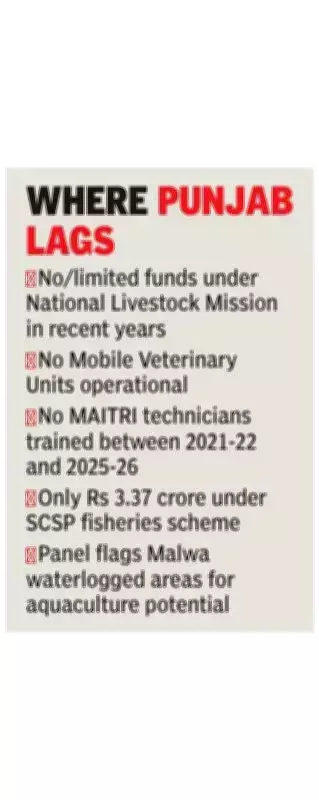
The committee's analysis reveals that Punjab is among the states that have received little to no funding under the National Livestock Mission over the past five years. This uneven distribution of resources under an employment-oriented scheme indicates a systemic bias that could hinder rural development and livelihood opportunities in the state.
Critical Infrastructure Shortfalls in Veterinary Services
Under the Mobile Veterinary Units (MVUs) component of the Livestock Health and Disease Control Programme, Punjab stands out as one of the states and union territories where no operational units exist. This is particularly alarming given the scheme's objective of deploying one unit for every one lakh livestock population, essential for timely animal healthcare.

Training Gaps in Artificial Insemination Initiatives
Furthermore, the state recorded zero training sessions under the MAITRI initiative from 2021-22 to 2025-26. This scheme aims to provide doorstep artificial insemination services to farmers, yet Punjab has been completely left out, even as over 40,000 technicians have been trained nationally under the programme.
Mixed Performance in Livestock Technology
On a positive note, Punjab has demonstrated strong performance in sex-sorted semen technology, achieving a female calf birth success rate of approximately 95%, which surpasses the national average. However, the committee noted that the conception rate remains lower compared to the regular artificial insemination programme, indicating areas for improvement.
Inadequate Funding for Scheduled Castes in Fisheries
The report also flagged low and inconsistent funding to Punjab under the Scheduled Castes Sub Plan (SCSP) component of the Pradhan Mantri Matsya Sampada Yojana. This is despite Punjab having one of the highest SC populations in the country at 31.9%. The state received merely Rs 3.37 crore under this scheme, significantly less than states like Haryana, Uttar Pradesh, and West Bengal.
Recommendations for Fisheries Development in Malwa Region
To address these disparities, the committee has recommended targeted efforts to promote fisheries in Punjab's waterlogged Malwa region. Proposed measures include:
- Cluster-based inland aquaculture development
- Expansion of allied activities such as ornamental fisheries
- Promotion of pearl farming initiatives
- Exploration of saline-water fisheries opportunities
The committee's findings underscore the urgent need for equitable fund distribution and enhanced infrastructure support to ensure Punjab's rural and agricultural sectors receive the attention they deserve from central schemes.