

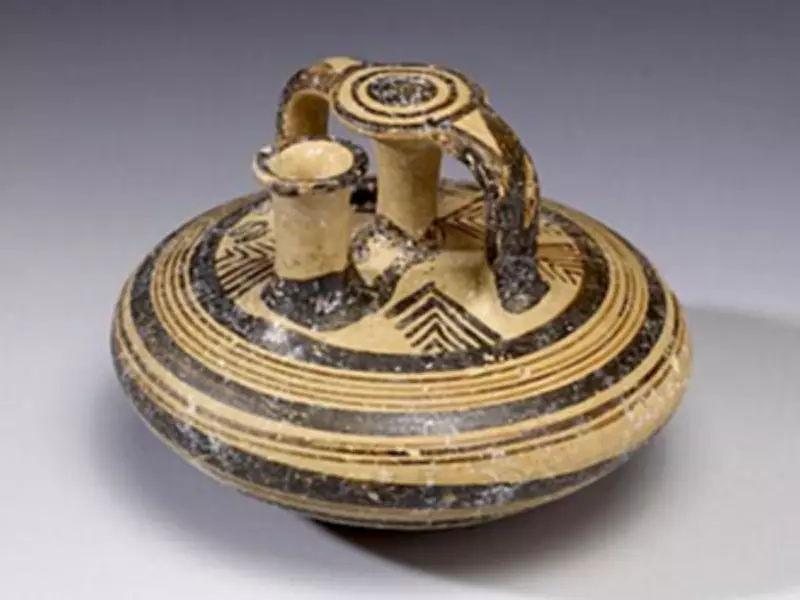
Imagine entering a workshop filled with the pungent smell of crushed pine resin, olive oil, and distilled laurel leaves. This is not a present-day parlor but an ancient workshop in Cyprus dating back 4,000 years. Archaeological finds from Cyprus point to a perfume workshop that offers new insight into ancient luxury. Perfume in the ancient world was a business involving politics, religion, trade, and science.
A Center of Trade in the Bronze Age
Cyprus was well positioned to become a center of fragrance production in the ancient world. The island was strategically located at the junction of important Mediterranean trade routes. Location, however, is not the only reason why Cyprus was able to develop its perfume industry. Cyprus had a unique natural landscape. The climate and diverse natural environment of the Troodos Mountains on the island enabled the growth of numerous plants with fragrant properties.
Craftsmen in Cyprus had detailed knowledge of different plants and herbs. They knew precisely when to harvest leaves and where to cut the bark to extract resin. Furthermore, local oil producers knew how to preserve scents with specific local oils and create unique products.

Scents as Symbols of Power
Making superior perfumes was extremely costly because the raw materials, such as expensive and hard-to-get tree gums and resins, had to be acquired. Because the raw materials were so scarce, perfume use and gift-giving were largely limited to the nobility. A research paper says scented gums and resins were part of trade exchanges as early as the mid-second millennium BCE. Scenting was used in important ceremonies, diplomatic agreements, embalming the dead, and medicine. Creating perfume out of natural and unprocessed plant material resulted in an elite product that carried huge economic and cultural significance.
Understanding the Hidden History in Smells
Archaeologists reconstruct ancient scents through molecular chemistry. Although the perfume's scent has dissipated over thousands of years, the containers it once filled remain. Modern laboratory methods can analyze residue preserved in the porous surfaces of ceramic pots and vessels that survive today. An entire paper, published in the journal Scientific Reports, has explained the scientific process through which researchers discover organic residue using biomarker analysis. Even after 4,000 years underground, these tests can reveal vegetable oils, animal fat, tree tars, and essential oils. The science involved here confirms that making perfumes in ancient times was a highly technical craft. People had to control fire and monitor temperatures, all while undergoing chemical reactions such as dry distillation.
An Enduring Legacy of Craftsmanship
The discovery at the Cyprus workshop shows the practical labor behind ancient luxury. Cyprus perfume makers built an industry that combined local environmental knowledge with international trade. Their sensory culture has influenced human identity for thousands of years. The original liquid has faded into history, but the legacy of the pottery and the chemistry it reveals persists.






