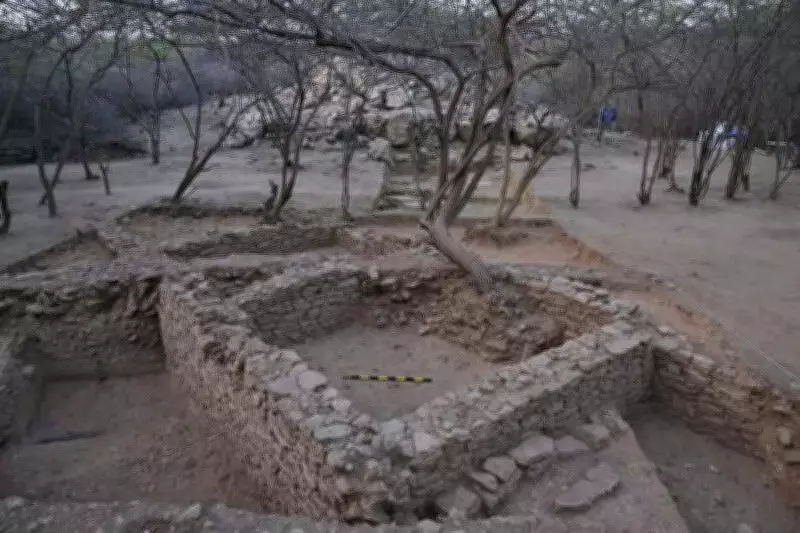
The Archaeological Survey of India has commenced its first large-scale, systematic excavation at Bet Dwarka, uncovering evidence of an ancient settlement with robust maritime activity and international trade connections dating back over two millennia.
Excavation details and objectives
Led by the ASI's underwater archaeology wing, the excavation began in December 2025 near the island's shoreline. Officials stated that the project aims to map the cultural sequence, settlement patterns, and maritime role of the region, marking a significant advancement in the study of India's coastal heritage.
Bet Dwarka has long been recognized as a crucial node in ancient trade networks. Scholars associate the site with 'Antardvipa' mentioned in literary traditions and with 'Baraca' cited in the Periplus of the Erythraean Sea, indicating its role in trade along India's western coast and possible links with the Roman world.

Key findings
According to Alok Tripathi, director of the excavation project, the team has uncovered deposits dating back approximately 2,200 to 2,300 years. 'We are trying to ascertain how ancient the Okha Mandal region is and understand the nature of habitation here,' he said.
The excavation has revealed extensive stone structural remains, including what appears to be a fortified complex with multiple chambers. Archaeologists believe the layout points to organized industrial and commercial activity within the settlement.
A wide range of artefacts has been recovered, including foreign pottery, glass beads, shell bangles, coins, and iron objects. Notable finds such as Roman coin impressions, amphora fragments, torpedo jars, and other imported ceramics indicate active overseas trade and contact with distant regions.
Challenges and future work
Fieldwork has been challenging due to dense vegetation and the presence of wildlife. Despite this, archaeologists have identified multiple habitation zones.
Earlier surveys had marked four areas — BSD-1 to BSD-4 — with pottery, shell debris, and structural features, indicating continuous human occupation from the protohistoric to early historic periods.
The ASI is also carrying out parallel offshore explorations near Dwarka alongside the onshore excavation at Bet Dwarka to build a more complete picture of the region's maritime past. Officials said the findings reinforce the view that Bet Dwarka was once a thriving coastal hub that played a key role in ancient trade networks and contributed to the region's economic life.