

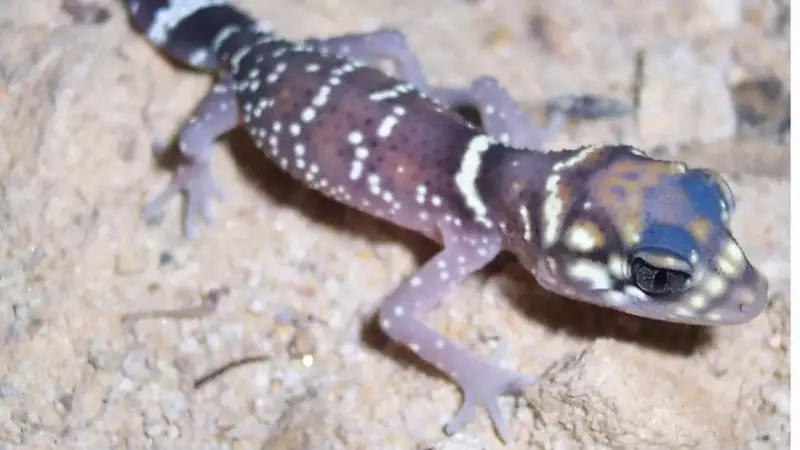
In the vast, sun-baked deserts of Southern Africa, a tiny reptile with a surprisingly loud voice defies the odds. This is the barking gecko, a small but fascinating creature whose unique adaptations and complex social sounds are captivating scientists and nature enthusiasts alike.
Mastering Life in the Sand: Physical Adaptations
Belonging to the genus Ptenopus, barking geckos are superbly specialised for desert life. Unlike many of their sticky-padded cousins who climb walls, these geckos have evolved strong, clawed feet perfect for one task: digging. Their small, sand-coloured bodies provide perfect camouflage against the desert floor. Their primary survival strategy revolves around the burrow. Using their specialised feet, they excavate intricate tunnels in the soft sand.
These burrows are far more than simple holes. They serve as a critical refuge from the desert's extreme daytime heat and dangerous predators like snakes and birds. The temperature inside remains cooler and more stable than the harsh external environment. These burrows are central to their entire life cycle, offering safety for hunting, social interaction, and even reproduction, which occurs safely underground to protect the young.

The Language of the Desert: Vocal Communication
What truly sets the barking gecko apart is its voice. In the reptile world, sophisticated vocal communication is exceptionally rare. Barking geckos, however, have mastered it. They produce a variety of distinct barks, each carrying a specific message. These vocalisations form a complex communication system that allows them to interact across the open, barren landscape.
Their calls serve multiple purposes. Some barks are territorial, warning rival geckos to keep their distance. Others function as mating signals to attract potential partners. Even the young emit soft barks to signal distress or call for adult attention. These are not random noises but a structured language. The barks vary in pitch, rhythm, and volume to convey different meanings. Remarkably, these sounds are powerful enough to travel several meters through sand and are louder than common desert background noise like wind.
Nocturnal Hunter in a Harsh World
Barking geckos are nocturnal creatures. They spend the scorching daylight hours sheltered in their burrows, emerging only after nightfall to hunt. Their diet consists mainly of insects and other small invertebrates, which they capture with stealth and agility. Despite their diminutive size, they are highly capable predators.
Their survival strategy is a powerful example of evolution at work. From specialised digging claws and camouflaged bodies to temperature-regulating burrows and a complex barking language, every aspect of their biology is fine-tuned for the desert. Scientists are particularly intrigued by their social vocalisations, as this behaviour challenges the long-held assumption that reptiles are mostly quiet and socially simple creatures. The barking gecko proves that even in one of Earth's most hostile environments, life finds a way—and sometimes, it even finds its voice.

