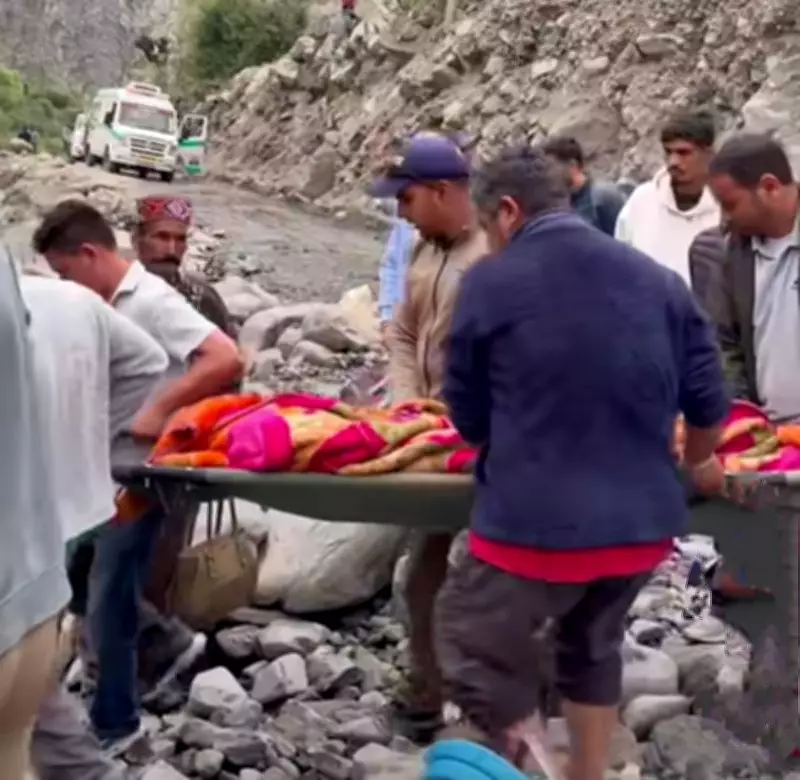
Personnel of the Border Roads Organisation (BRO) successfully evacuated a critically ill woman across the flooded Jahalma nallah in Lahaul-Spiti district on July 1, 2026, enabling her to reach advanced medical care despite completely disrupted road connectivity.
The patient, Shanti Devi, a resident of Shainur village, had been undergoing treatment at the Civil Hospital in Udaipur. As her condition worsened, doctors referred her to the Regional Hospital in Kullu for specialised treatment. However, the swollen nallah blocked all movement, as the water level had risen sharply, making the route impassable.
BRO's swift rescue operation
As a precautionary measure, the BRO had earlier removed the RCC pipes laid on the temporary road and the girders used for pedestrian movement to ensure public safety. Displaying prompt action and humanitarian commitment, BRO personnel used an LNT earthmoving machine to transport Shanti Devi across the turbulent stream. Seated safely in the machine's bucket, she was taken to the opposite bank, where an ambulance stood ready. She was immediately shifted into the ambulance and rushed to Kullu for further treatment.

Dr Himesh Thakur of Civil Hospital, Udaipur, said the patient was suffering from a severe chest infection accompanied by acute breathing difficulties. Considering her critical condition, doctors decided to refer her to Kullu without delay.
Impact and significance
The timely intervention by the BRO ensured that the patient could be safely evacuated despite challenging weather conditions and disrupted road access, highlighting the organisation's crucial role during emergencies in remote hill regions. This operation underscores the importance of preparedness and rapid response in disaster-prone areas, where infrastructure is often vulnerable to natural elements.
The successful rescue also reflects the coordination between local health authorities and the BRO, which frequently assists in civil emergencies in the high-altitude terrain of Himachal Pradesh. The incident has drawn attention to the need for robust contingency plans in areas prone to flash floods and landslides.