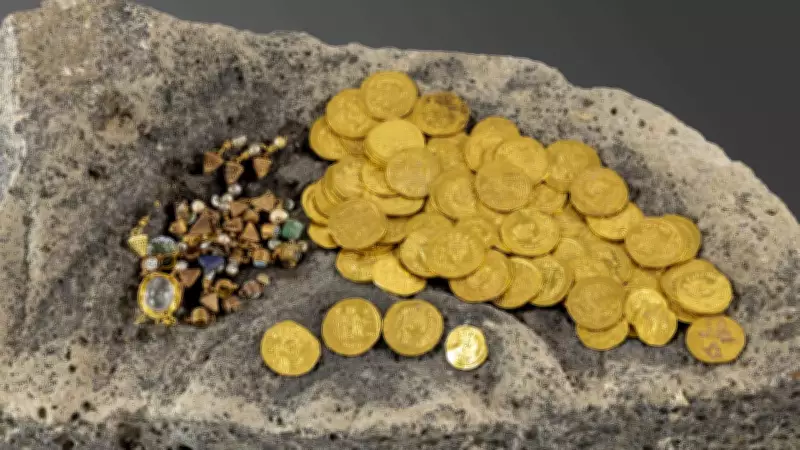
Archaeologists conducting a routine metal detector sweep in the ancient city of Hippos, also known as Sussita, overlooking the Sea of Galilee, have uncovered a remarkable Byzantine-era treasure. The cache, containing 97 gold coins and fragments of fine jewelry, dates back approximately 1,400 years and was hidden beneath a large stone between two walls during a period of conflict. The hoard remained untouched for over fourteen centuries, offering a rare glimpse into the lives of people during one of the most turbulent chapters in Byzantine history.
Discovery of the Hoard
The treasure was found in July 2025 during excavations at Hippos. Metal detector operator Edie Lipsman detected an unusually strong signal near a large stone situated between two walls. As the stone was carefully moved, gold coins began emerging from the soil. According to Dr. Michael Eisenberg, co-director of the Hippos excavation project, the discovery represents one of the largest Byzantine gold hoards ever found on dry land in Israel. The sheer quantity of gold, combined with the excellent preservation of the objects, immediately attracted the attention of researchers.
Contents of the Cache
The cache contained 97 gold coins alongside fragments of luxurious jewelry, including gold earrings decorated with pearls, glass, and semi-precious stones. Researchers identified the coins as Byzantine solidi, semisses, and tremisses — denominations used for major financial transactions and the storage of wealth. The collection spans nearly a century, beginning with coins issued during the reign of Emperor Justin I in the early sixth century and extending into the early years of Emperor Heraclius in the seventh century. One of the most important discoveries was a tremissis believed to have been minted in Cyprus around AD 610, providing archaeologists with an important chronological marker.

Personal Story Behind the Jewelry
While the gold coins reveal economic and political history, the jewelry offers a more intimate glimpse into the lives of the people who once owned the treasure. Among the finds were fragments of finely crafted earrings decorated with pearls and ornamental stones. Archaeologists also identified traces of fabric adhering to some of the coins, suggesting the valuables were originally stored in a cloth pouch before being buried beneath the stone. This small detail transforms the discovery from a collection of precious metals into something much more human — rather than a ceremonial deposit or official treasury, the hoard appears to have been someone's personal wealth carefully concealed during a time of uncertainty.
Why Was the Treasure Buried?
The most convincing explanation lies in one of the major conflicts of the early seventh century. Around AD 614, Sasanian Persian armies swept through Byzantine Palestine, capturing major cities and creating widespread instability throughout the region. Communities faced military threats, economic disruption, and uncertainty about the future. In such circumstances, hiding valuable possessions was often the safest option available. Archaeologists believe the owner of the Hippos treasure may have buried the gold and jewelry with the intention of returning once the danger had passed. For reasons that remain unknown, that never happened. The owner may have fled, been killed, displaced by the conflict, or simply lost the opportunity to recover the hidden wealth.
The Ancient City of Hippos
Hippos, located on a steep hill east of the Sea of Galilee, was one of the prominent cities of the Decapolis, a network of Greco-Roman urban centers spread across the region. During the Roman and Byzantine periods, the city thrived as a center of trade, religion, and administration. Archaeological excavations have revealed churches, public buildings, workshops, residential neighborhoods, and sophisticated infrastructure. The city occupied a strategic position overlooking important trade routes and surrounding agricultural lands. Its prosperity is reflected in discoveries such as the newly uncovered treasure. Hippos continued to exist into the early Islamic period before suffering catastrophic destruction during a powerful earthquake in AD 749, effectively ending the city's history.

What the Coins Tell Archaeologists
Ancient coins are among the most valuable archaeological tools because they carry precise information about rulers, dates, and political authority. The Hippos hoard provides researchers with a rare opportunity to examine economic life in the final decades of Byzantine rule in the region. Each coin carries details that help reconstruct patterns of trade, wealth accumulation, and imperial administration. Because the coins span the reigns of multiple emperors, they also help establish a timeline connecting local events in Hippos with broader developments across the Byzantine Empire. Combined with the jewelry and associated artifacts, the hoard offers an unusually detailed snapshot of life during a period of profound political change.
More Than a Treasure
The true significance of the discovery lies not in the gold itself but in the human story it preserves. At some point around fourteen centuries ago, someone made the difficult decision to hide their most valuable possessions beneath a stone. The choice was likely driven by fear, uncertainty, and hope — fear of losing everything, uncertainty about what lay ahead, and hope that one day they would return. That return never came. Instead, the treasure remained buried as empires rose and fell, religions spread, borders shifted, and entire civilizations changed. Only a chance signal from a metal detector brought the hidden cache back into the light. Today, the gold coins and jewelry of Hippos serve as a powerful reminder that behind every archaeological discovery lies a human story — in this case, the story of a prosperous Byzantine city, a time of war and upheaval, and an individual whose attempt to protect their wealth survived for more than 1,400 years.