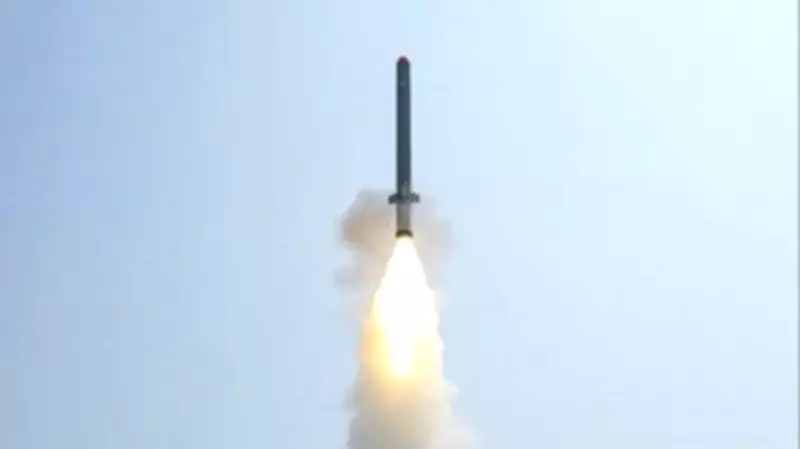
The Defence Research and Development Organisation (DRDO) on Monday successfully flight-tested the indigenously developed Long Range Land Attack Cruise Missile (LRLACM) from Dr APJ Abdul Kalam Island off the Odisha coast, marking a significant milestone in India’s long-range precision strike capability.
The missile met all mission objectives, validating critical technologies across propulsion, guidance, navigation and control, and warhead delivery, according to officials. Engineered and integrated by DRDO with extensive participation from Indian industry, the LRLACM demonstrated accurate midcourse and terminal phase performance during the trial.
The missile’s flight envelope confirmed the robustness of its navigation and guidance algorithms, its terrain-following capability, and its propulsion system under operational conditions. Range, flight profile adherence and target impact parameters were reportedly within expected tolerances, providing confidence for subsequent development and deployment phases.

Strategic Implications
The successful trial has strategic and operational ramifications. A credible long-range land-attack cruise missile enhances India’s ability to strike high-value, time-sensitive targets deep inside adversary territory while retaining flexible launch options and low-signature flight profiles. For military planners, LRLACM expands the toolkit for deterrence and calibrated response, particularly in scenarios that favor stand-off precision effects over kinetic large-scale strikes.
Indigenous Development
DRDO states the missile’s subsystems were developed domestically with strong involvement from Indian private and public sector firms, reflecting the government’s Aatmanirbhar Bharat objective to build a self-reliant defence industrial base. Localised manufacturing and systems integration reduce lifecycle costs, simplify logistics, and allow faster upgrades as threat profiles evolve.
About LRLACM
The Long Range Land Attack Cruise Missile (LRLACM) is a subsonic, surface-launched cruise missile designed to strike land targets at long distances with high precision. It integrates a turbofan or turbojet propulsion unit for sustained flight, an advanced inertial navigation system augmented by satellite navigation for midcourse guidance, and a terminal seeker or terrain-contour matching capability for accurate target engagement.
Designed for low-altitude, terrain-hugging flight, the LRLACM minimises detection and interception risk while delivering a conventional warhead on designated high-value targets. The indigenous program focuses on modular subsystems, export potential under policy constraints, and compatibility with diverse launcher platforms to maximise operational flexibility.