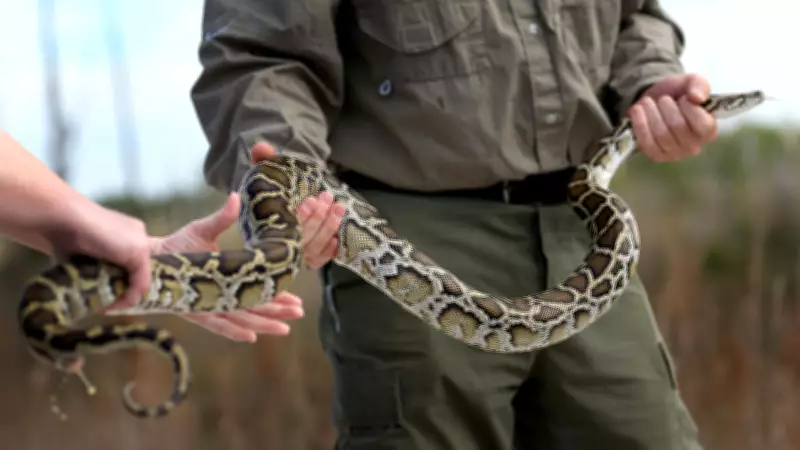
Florida scientists have achieved a major milestone in the fight against one of the state's most destructive invasive species. During the latest breeding season, researchers removed a staggering four tons of invasive Burmese pythons from South Florida ecosystems, including a massive 17-foot female weighing 153 pounds. The operation also led to the removal of more than 4,100 python eggs before they could hatch. The record-breaking effort, carried out by the Conservancy of Southwest Florida, highlights both the scale of the python problem and the innovative methods scientists are using to protect the fragile Everglades ecosystem from these formidable predators.
Four Tons of Burmese Python Removed in a Single Season
The Conservancy of Southwest Florida announced that its python tracking team and volunteers captured 177 Burmese pythons between November 2025 and April 2026. Together, the snakes weighed 8,080 pounds, equivalent to four tons, making it the largest biomass removal season since the organisation launched its python programme in 2013.
Researchers monitored approximately 200 square miles of habitat in Collier County during the peak breeding season. The captured females averaged around 95 pounds in weight, while the largest measured 17 feet long and tipped the scales at 153 pounds. The achievement reflects years of refining techniques aimed at locating breeding females before they have an opportunity to reproduce and further expand the invasive population.

The Secret Weapon: 'Scout Snakes'
One of the most successful tools in Florida's python management strategy involves the use of radio-tagged male pythons known as "scout snakes." Scientists capture adult males, implant radio transmitters and release them back into the wild. During the breeding season, these males naturally seek out females. By tracking the movements of the tagged snakes, researchers can locate hidden breeding females deep within remote wetlands that would otherwise be nearly impossible to find.
Wildlife biologist Ian Bartoszek, who pioneered the Conservancy's python programme, credited the tagged snakes for helping researchers find large breeding females before they laid eggs.
"This was our first four-ton removal season. Our tagged scout snakes helped us locate large breeding snakes deep in the landscape before they had a chance to lay eggs," Bartoszek said.
More Than 4,100 Eggs Stopped Before Hatching
Preventing reproduction is a key objective of the programme. During the latest season alone, researchers removed more than 4,100 Burmese python eggs from the ecosystem. The captured females contained an average of 70 eggs each. Considering that female Burmese pythons can lay between 50 and 100 eggs annually, removing breeding females can prevent thousands of future snakes from entering the Everglades. Scientists view egg removal as one of the most effective ways to slow population growth because it directly interrupts the species' reproductive cycle.
Why Burmese Pythons Are Such a Threat
Burmese pythons are native to Southeast Asia but became established in Florida after entering the exotic pet trade. Experts believe many were released into the wild by owners who could no longer care for them as they grew larger and more difficult to manage. Today, the giant constrictors are considered one of the greatest threats to the Everglades ecosystem. They consume a wide range of native wildlife, including birds, rabbits, raccoons and even deer. The latest findings illustrate the scale of their impact. Researchers reported that one in four captured females contained remains of white-tailed deer in their stomachs, demonstrating the snakes' ability to prey on large mammals. Numerous scientific studies have documented severe declines in native mammal populations in areas where Burmese pythons have become established.

Why These Giant Snakes Are So Difficult to Control
Despite years of removal efforts, Burmese pythons remain exceptionally challenging to manage. Their camouflage allows them to blend seamlessly into marshes, swamps and dense vegetation. The vast size of the Everglades further complicates detection efforts, as snakes can remain hidden across thousands of square miles of habitat. Their reproductive potential also works in their favour. A single female can produce dozens of offspring each year, enabling populations to rebound rapidly if left unchecked. Scientists therefore focus on reducing reproduction rather than attempting complete eradication, which many experts believe is no longer realistic.
A Record That Could Signal Progress
While the removal of four tons of pythons highlights the magnitude of Florida's invasive snake problem, researchers see the record-breaking season as evidence that their methods are becoming more effective. Bartoszek said the science-based management strategy is helping reduce local reproduction and improve understanding of python behaviour. "With consistent pressure, we hope to see these removal numbers decline over time," he said. Since the programme began in 2013, the Conservancy has removed more than 1,750 pythons weighing over 53,000 pounds from Southwest Florida. Each captured snake and every removed clutch of eggs reduces pressure on native wildlife and gives vulnerable species a better chance of recovery.
The Battle for the Everglades Continues
The Everglades remains one of the most unique ecosystems in North America, supporting countless species found nowhere else. Protecting it from invasive predators has become a long-term conservation challenge. The latest record-breaking season demonstrates that while Burmese pythons continue to pose a serious threat, researchers are finding increasingly effective ways to limit their impact. With the help of innovative tracking methods and years of field experience, Florida's scientists are steadily turning the tide in one of the world's most unusual wildlife management battles.