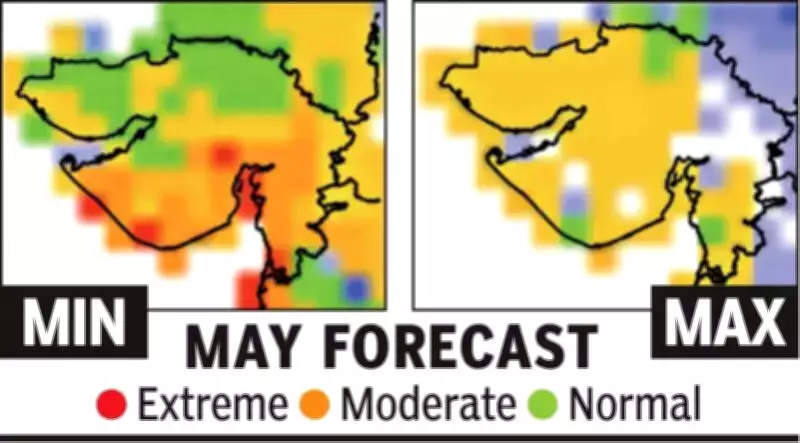
Ahmedabad: If you thought the April sun was harsh, prepare for more challenging weather ahead. Gujarat is heading into a hotter-than-usual May, with weather officials warning of a higher number of heatwave days and more prolonged spells. Additionally, nights are expected to remain warmer, adding to overall discomfort, according to the long-range forecast (LRF) for May released by the India Meteorological Department (IMD) on Friday.
Temperature Outlook for May
Mrityunjay Mohapatra, Director General of Meteorology at IMD, stated, "Minimum temperatures are expected to remain above normal across large parts of the country during May." The forecast indicates that maximum temperatures in Gujarat will be above normal in most areas, except for some pockets in northeast Gujarat. Minimum temperatures are expected to be significantly higher in peninsular Saurashtra and south Gujarat, moderately higher in central Gujarat, and close to normal in Kutch and north Gujarat.
Heatwave Conditions
The heatwave outlook points to a higher likelihood of heatwave conditions in Saurashtra and Kutch, as well as parts of central and south Gujarat. Officials have cautioned that the combination of higher day and night temperatures could intensify heat stress. In April, most parts of the country experienced normal to below-normal maximum temperatures, with variability due to seven Western Disturbances influencing weather conditions. However, southern peninsular India saw above-normal heat.

Rainfall Forecast
On rainfall, IMD has projected above-normal precipitation across most parts of the country in May. However, some regions in east, northeast, and east-central India may receive below-normal rainfall. In Gujarat, most areas are expected to receive above-normal rainfall, except for a few locations in coastal Saurashtra.
Monsoon Onset
Regarding the onset of the southwest monsoon, Mohapatra said, "The monsoon may arrive over the Andaman and Nicobar Islands around May 14-16." This development is closely monitored as it signals the start of the monsoon season for the Indian subcontinent.
The combination of above-normal temperatures and increased rainfall variability underscores the need for preparedness against heat stress and potential weather extremes in the coming weeks.