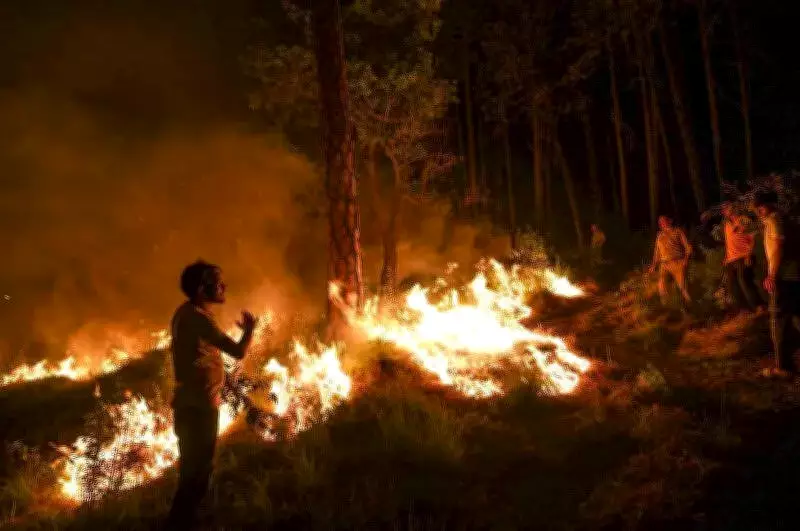
Rising temperatures and prolonged dry conditions have triggered a fresh wave of forest fires across Himachal Pradesh, with the state already recording 288 fire incidents this season, destroying nearly 3,672 hectares of forest area and raising environmental concerns and losses worth crores of rupees.
Incident Distribution Across Forest Circles
According to data from the state forest department, the highest number of fire incidents was reported in the Mandi forest circle, where 92 events were recorded during the ongoing summer season. Despite recording only eight major fire incidents till Friday, the Shimla forest circle suffered the maximum damage in terms of area burnt, with around 1,573 hectares affected by the fires. In comparison, about 536 hectares of forest area was damaged in the Mandi circle.
The Dharamshala forest circle recorded the second-highest 72 fire incidents, followed by 56 incidents in the Nahan circle. Hamirpur circle recorded 24 incidents, Solan 11, Bilaspur 10, Chamba and Wildlife South circle six each, the Great Himalayan National Park in Kullu registered two incidents and Rampur one.

Yearly Trends and Comparisons
The forest department records show fluctuating trends in fire incidents over the years. While 276 forest fires were recorded during the summer season last year, the state witnessed an alarming 2,433 incidents in 2024, 110 incidents were reported in 2023, 758 in 2022 and only 15 in 2021. This year, after Shimla, the Nahan forest circle reported the second-largest area damaged by fires, with nearly 610 hectares burnt. In Dharamshala, 260 hectares were affected, in Hamirpur 250 hectares, Solan 209 hectares, Wildlife South circle 87 hectares, Bilaspur 67 hectares, Chamba 51 hectares, Great Himalayan National Park 25 hectares and Rampur four hectares.
Ecological and Human Impact
The impact of forest fires ranges from burning of dry grass and mainly Pine and Deodar leaf litter, during ground fires, to severe ecological destruction when fires spread to tree canopies and turn into crown fires. Such fires threaten biodiversity, wildlife habitats and the fragile Himalayan ecology. In several cases, fires also endanger nearby villages and human settlements.
Causes: Human Activities and Climate Factors
A study conducted by the state forest department attributed almost all forest fires in Himachal Pradesh to human activities, both intentional and accidental, besides soaring temperatures during summers. Unintentional causes include discarded cigarette and bidi stubs, burning matchsticks, unattended fires lit by travellers or graziers, sparks from electric poles and the spread of flames from stubble burning in agricultural fields.
Intentional forest fires are often linked to attempts to induce fresh grass growth during summers, promote gucchi mushroom growth, facilitate the collection of forest produce, destroy evidence of illegal tree felling or drive away wild animals from villages. The department has urged people to exercise caution and cooperate in preventing forest fires during the dry season.
Officials say hot weather, dry winds and highly combustible chir pine forests create ideal conditions for fires to spread rapidly during summer months. The resin-rich pine needles dry quickly and can catch fire from even a minor spark.
Fears of Repeat of Devastating 2024-25 Season
The latest surge has revived fears of a repeat of the devastating 2024-25 summer fire season, when Himachal Pradesh witnessed 2,433 forest fire incidents, making it one of the worst years in recent times. Dharamshala forest circle recorded the highest 541 fires, followed by Mandi with 377, Chamba with 281, Nahan with 275 and Hamirpur with 264 incidents. Nearly 20,000 hectares of land was affected during the season.

Prevention and Mitigation Strategies
According to Dharamshala forest circle chief conservator of forests (CCF) Basu Kaushal, prevention before the fire season begins remains the department's main strategy. "Our priority is prevention before the fire season begins. We identify vulnerable forest areas through digital mapping, carry out controlled burning where required, and conduct awareness campaigns involving local communities. Fire detection is no longer the biggest challenge because we now receive satellite-based alerts and have established control rooms at range and divisional levels. The real challenge is mitigation, which is actually reaching and controlling fires in difficult terrain," said Kaushal.
She said inaccessible terrain remains one of the biggest hurdles during firefighting operations. "Most incidents happen in remote and steep areas where access is extremely difficult, yet our staff remain on duty round the clock, often risking their lives," she added, noting that most forest fires are caused by human activity, often unintentionally. "People burn grasslands or casually discard cigarette butts without realising how quickly dry pine needles can turn a small spark into a raging forest fire. There is also a widespread belief in some areas that setting ghasinis or grasslands on fire leads to better fodder growth for livestock in the next season. In reality, repeated fires devastate the ecosystem, destroy wildlife habitat and push wild animals closer to human settlements," she explained.
According to state fire department chief fire officer Sanjiv Kumar, difficult terrain and lack of road connectivity make forest fire operations extremely challenging. "If there is road accessibility to a burning forest, it becomes easier to bring the fire under control. However, in most cases there is no accessibility, yet we still carry water cannons and other equipment to the fire spots and try our best," Kumar said.
He emphasised that prevention remained the best solution to the growing menace of forest fires. "Forest fire incidents increase during the dry and hot summer months as dry leaves and pine needles act as combustible material. Pine needles, especially, act like petrol. A little spark anywhere and the whole forest is on fire. The effort should be to remove all this material with community participation," he added.
Historical Data on Forest Fires in Himachal Pradesh
The following table summarises forest fire incidents and losses over recent years:
- 2021-22: 33 incidents, 246 hectares affected, loss Rs 70,000
- 2022-23: 857 incidents, 9,020 hectares affected, loss Rs 70 lakh
- 2023-24: 685 incidents, 10,918 hectares affected, loss Rs 32 lakh
- 2024-25: 2,613 incidents, 32,494 hectares affected, loss Rs 283 crore
- 2025-26 (ongoing): 561 incidents, 1,791 hectares affected, loss Rs 14 lakh
Source: HP Forest Department
Current Season Fire Incidents by Circle
- Mandi: 83
- Dharamshala: 59
- Nahan: 52
- Hamirpur: 17
- Solan: 10
- Bilaspur: 9
- Shimla: 8
- Chamba: 6
- Wildlife South: 4
- Kullu: 2
- Rampur: 1
The forest department continues to urge residents and visitors to remain vigilant and report any signs of fire immediately to prevent further damage.