

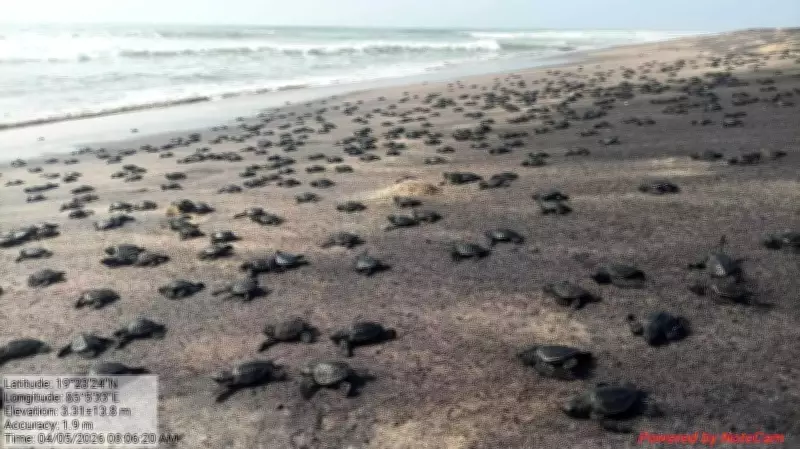
The much-awaited mass hatching of Olive Ridley turtles commenced at the Rushikulya river mouth in Ganjam district, Odisha. Over the past two days, thousands of turtle hatchlings have emerged from sandy pits and crawled toward the sea during the early morning hours.
Hatching Process and Timeline
Sunny Khokar, Divisional Forest Officer (DFO) of Berhampur, stated that mass hatching typically occurs 50 to 60 days after nesting. This year, it began on schedule and is expected to continue for the next three to four days. During the mass nesting period from March 14 to 17, a total of 2.05 lakh Olive Ridley turtles laid eggs on the beach. After laying eggs, female turtles return to the sea without waiting for their offspring to hatch.
Protective Measures for Hatchlings
Assistant Conservator of Forest (ACF) Dibya Shankar Behera outlined several measures taken to ensure the safety of the baby turtles. Local volunteers and wildlife activists are assisting forest personnel in protecting the turtles. The entire nesting area has been fenced to prevent entry of predators such as wild dogs, jackals, and hyenas. Patrolling on the beach has been intensified to protect hatchlings from birds and wild animals. The forest department has declared the area a no-entry zone.

Volunteers have been collecting some turtles in buckets to divert them from hazardous paths and releasing them into the sea. Around 40 volunteers are engaged in this effort. Additionally, the forest department has requested nearby industries, Gopalpur port, and civic authorities in Ganjam to dim streetlights at night to prevent hatchlings from being attracted toward artificial light sources.
Community and Research Involvement
Numerous people and researchers have gathered at the rookery to witness this natural phenomenon. Rabindra Nath Sahu, secretary of the Ganjam district sea turtle protection committee, remarked that this reflects strong community participation in wildlife protection.






