

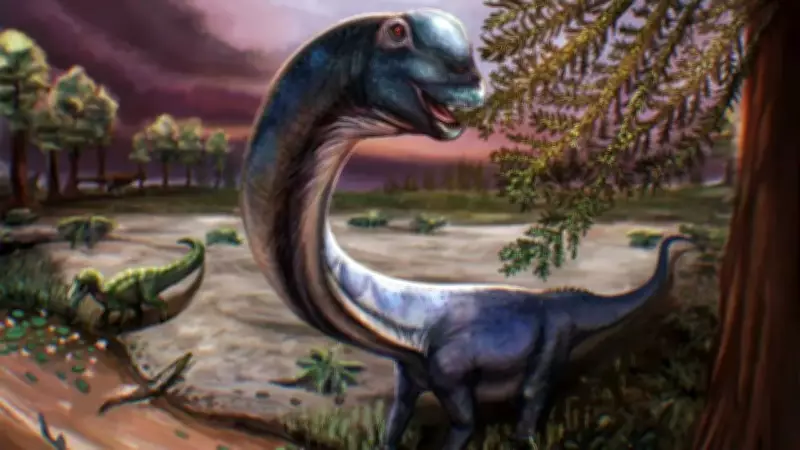
In a discovery that has stunned the scientific community, a small Thai village has revolutionized the field of paleontology. A routine morning walk in Chaiyaphum province, northeastern Thailand, led to the unearthing of a new species of giant long-necked dinosaur, named Nagatitan. This colossal herbivore, weighing 27 tonnes and measuring 27 meters in length, is the largest dinosaur ever found in Southeast Asia.
Discovery of Nagatitan
A villager stumbled upon massive bones protruding from the ground near a pond and alerted authorities. Subsequent excavations revealed the remains of a previously unknown sauropod. The dinosaur's full name, Nagatitan chaiyaphumensis, combines "naga" (a serpent from Southeast Asian folklore), "titan" (from Greek mythology), and "chaiyaphumensis" (referring to the province of discovery).
Size and Classification
Nagatitan weighed as much as nine adult Asian elephants and was longer than a diplodocus. It belonged to the sauropod family of long-necked herbivores, considered the largest land animals ever. It lived between 100 and 120 million years ago, about 40 million years before the Tyrannosaurus rex, and was roughly twice its size. Scientists identified unique anatomical features, such as specific bony wedges in its vertebrae, distinguishing it from South American relatives like Patagotitan and Argentinosaurus.

Scientific Significance
A team from the UK and Thailand identified the species from fossils found a decade ago. The discovery provides insights into how ancient climatic conditions enabled gigantic dinosaurs to thrive. Thitiwoot Sethapanichsakul, a Thai doctoral student at University College London and lead author of the study published in Scientific Reports, described Nagatitan as "the last titan" of Thailand. The fossils were found in the country's youngest dinosaur-bearing rock formation, suggesting that later rocks formed when the region was a shallow sea, making further large sauropod finds unlikely.
Evolutionary Context
Nagatitan belongs to the Euhelopodidae lineage, which originated around 140 million years ago and achieved global distribution. Around 90 million years ago, they became the only surviving sauropods, thriving until the dinosaur extinction 66 million years ago. The dinosaur lived during a period of rising atmospheric carbon dioxide and global temperatures. Co-author Professor Paul Upchurch of UCL noted that it seems unusual for sauropods to cope with high temperatures, as large bodies retain heat. He suggested that high temperatures may have affected the plant fodder important to these large herbivores.
Implications for Paleontology
The discovery confirms a unique evolutionary lineage that thrived independently due to geographic barriers, challenging previous theories about maximum herbivore size in Southeast Asia during the mid-Cretaceous period. Thailand has only conducted systematic dinosaur research for four decades, yet Nagatitan is the 14th dinosaur named in the country. Paleontologist Dr. Sita Manitkoon from Mahasarakham University noted that Thailand has high dinosaur fossil diversity and is "possibly the third most abundant in Asia in terms of dinosaur remains."
A life-size reconstruction of Nagatitan is currently displayed at Bangkok's Thainosaur Museum.






