

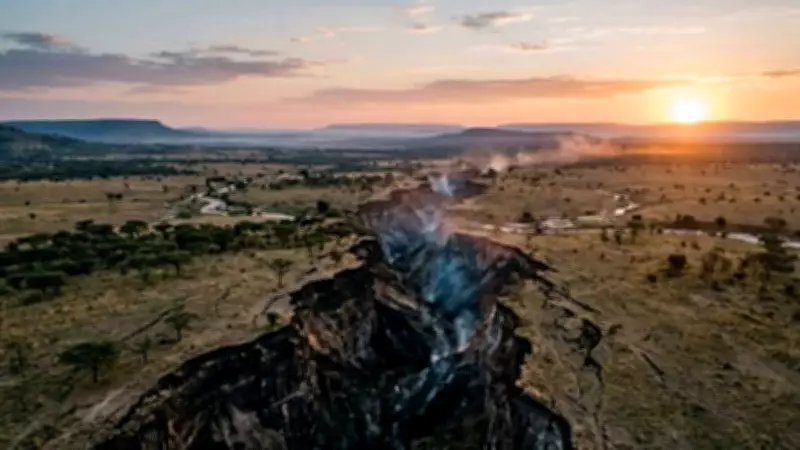
A groundbreaking study reveals that Africa may be undergoing a monumental geological transformation, as researchers identify a potential new tectonic plate boundary forming in Zambia. By analyzing isotope signatures from geothermal springs, scientists have discovered that the Southwest African Rift (SWAR) is significantly more active than previously believed. According to a report published in Frontiers, this 'geological awakening' indicates that the Earth's lithosphere might be starting to break apart along the Kafue Rift, representing the early phases of a continental split. Although this shift will take millions of years to eventually alter the world map, it offers a unique opportunity to observe how a tectonic boundary begins and the deep-mantle forces driving it.
Helium Reveals Deep Mantle Connection
Scientists have found the primary evidence for this tectonic change by studying rare isotopes in the thermal springs around the Kafue and Luano rifts. They detected high levels of Helium-3, a primordial isotope that has been present in the Earth's mantle since the planet's formation. Normally, thick continental crust traps these gases. However, their emergence in Zambia's springs indicates that fault lines have breached the entire lithosphere, reaching depths of nearly 100 kilometers. This direct pathway to the mantle shows that the crust is thinning, allowing deep-earth gases to migrate toward the surface.
How the Southwest African Rift Is Reshaping the Continent
The East African Rift is renowned for its geological significance, but now Zambia is emerging as a crucial area for tectonic research. Previously, the Southwest African Rift was not considered highly active. However, new findings reveal that it plays a key role in shaping Africa's structure. Researchers have discovered that the rift undergoes significant geochemical activity, meaning Earth's heat and pressure are actively altering the region below the surface. This breakthrough provides scientists with a unique chance to observe plate tectonics in action and helps them understand how continents break apart over time into smaller landmasses.

How the New Plate Boundary Could Fuel the Future
Zambia's active rifting process is not only fascinating for scientists but also carries significant economic implications for the region's energy future. With the mantle's proximity to the surface in these areas, there is high potential for geothermal energy, offering Zambia a steady and renewable power source. Moreover, deep faults here often release helium and contain natural hydrogen and valuable helium gas. These resources are essential for modern medical tools and the transition toward green energy. Thus, this new plate boundary could become a key site for sustainable resource extraction in the future.
About the Author
The TOI Science Desk is an inquisitive team of journalists, ceaselessly delving into the realms of discovery to curate a captivating collection of news, features, and articles from the vast and ever-evolving world of science for the readers of The Times of India. Consider them your scientific companion, delivering a daily dose of wonder and enlightenment. Whether it is the intricacies of genetic engineering, the marvels of space exploration, or the latest in artificial intelligence, the TOI Science Desk ensures you stay connected to the pulse of the scientific world. At the TOI Science Desk, they are not just reporters; they are storytellers of scientific narratives. They are committed to demystifying the intricacies of science, making it accessible and engaging for readers of all backgrounds. Join them as they craft knowledge with precision and passion, bringing you on a journey where the mysteries of the universe unfold with every word.






