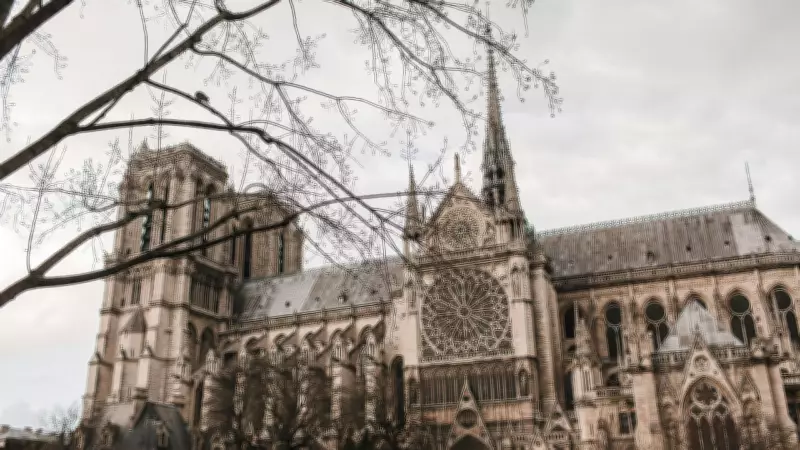
An important dig below Notre-Dame is speculated to be the "dig of the century" for it uncovered around 1,700 years of Paris history in the cathedral's forecourt. Archaeologists hit Roman layers and found numerous artifacts, such as a fourth-century coin, oddly marked medieval pottery, and old house remains. These finds illustrate how the Île de la Cité evolved from a Roman settlement into a medieval hub, ultimately becoming the site of Notre-Dame. This project provides researchers and visitors with key original clues that reshape local history. There are also valuable opportunities for dating, preservation, and public display.
What archaeologists found beneath the cathedral: Coins, pottery, and Roman layers
According to a press release by République Française, this excavation is significant because it reveals a continuous record of human activity in the heart of Paris. The Roman layers indicate that Lutetia extended further than previously thought, while Merovingian and Carolingian remains show the area was important for religious and residential purposes long before the cathedral was built. The oldest levels date back to the beginning of Antiquity. Teams uncovered the floor of a residence from the very beginning of the 1st century at a depth of 3.50 meters in the Soufflot crypt at the cathedral's center. From the Late Roman Empire, housing and craft artifacts, including burnt soil and wood, were discovered under the square.
With intact tombs, household trash, and construction waste, researchers gain firsthand insight into everyday life, trade, and building methods through the centuries. According to the Ministry of Culture and Institut National de Recherches Archéologiques Préventives (INRAP), "Stratigraphic layers reveal streets, houses, and religious structures that predate the cathedral's construction," as well as "a fourth-century coin and undeciphered pottery markings offering direct evidence of how Lutetia transitioned into medieval Paris." Among the unearthed burials, a fully preserved anthropomorphic lead sarcophagus was discovered. Initial analysis of grave goods in the overlying fill layer suggests this burial dates to at least the 14th century. Given its characteristics and location, the hypothesis that it was the burial of a high-ranking official seems likely. Such a consistent timeline is extremely rare in a major European city, making it a fantastic benchmark for dating other sites in Paris.

How experts dated the finds and what official reports say
Dating relied on a combination of numismatic analysis (the fourth-century Constantine coin), ceramic typology (pottery shapes and manufacturing marks), and stratigraphic correlation with known Parisian building phases. Primary reports from the excavation team note that the coin's mint mark and wear pattern anchor the upper Roman layer to the early fourth century, while pottery from the same stratum matches known late-Roman wares. For top-level accuracy, the team cross-referenced soil samples with dendrochronology results from nearby medieval foundations. These methods together provide a robust chronology that can be used in future research and museum interpretation.
What this means for visitors and the cathedral's reopening
These findings will affect how visitors experience Notre-Dame when it reopens after restoration. Authorities plan to establish an on-site archaeological garden and interpretive center by the Soufflot crypt. They will showcase important items such as the lead sarcophagus, a fourth-century coin, and pottery pieces. This setup allows the public to view the Roman floor and medieval foundations in their original locations. Additionally, information boards and digital reconstructions will help visitors visualize the area's transformations. By linking these physical remains to the cathedral's history, they become an integral part of the site's ongoing story. This enhances our understanding of why Notre-Dame was built in this specific location and provides insight into 1,700 years of Parisian life.