

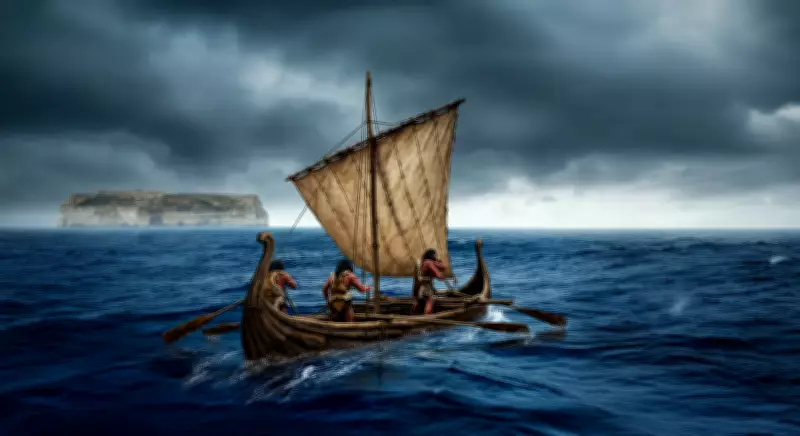
For much of the twentieth century, archaeologists believed that early humans avoided crossing open water and that true seafaring began only after farming societies emerged and developed more advanced tools. A series of recent excavations across the Mediterranean and Southeast Asia is now overturning that long-held assumption.
Malta's 8,500-Year-Old Discovery Rewrites Mediterranean Seafaring History
On the remote island of Malta, researchers have found clear evidence that Stone Age hunter-gatherers were crossing more than 100 kilometres of open sea at least 8,500 years ago, a thousand years before farmers ever reached the island. The discovery, along with a string of other recent finds stretching from Indonesia to the Pacific, suggests that the human relationship with the ocean goes back far further than anyone had previously imagined.
Malta sits roughly 85 kilometres from Sicily, its nearest neighbour, and cannot be seen from any landmass, including Sicily itself. Reaching it by canoe would have meant paddling for over a day and navigating by starlight once night fell. Yet between 2021 and 2023, a team led by archaeologist Eleanor Scerri of the Max Planck Institute of Geoanthropology excavated a sinkhole site called Latnija in northern Malta and found hearths, stone tools, and butchered deer bones dating back roughly 8,500 years. The findings, published in Nature in April 2025, pushed back the known human presence on Malta by more than a thousand years and showed that the people who made this crossing were hunter-gatherers, not farmers with more sophisticated boats. This is now considered the oldest confirmed evidence of long-distance seafaring in the Mediterranean.

How Stone Age Hunter-Gatherers Crossed Open Water Without Sails or Metal Tools
The Malta discovery raises an obvious question: how did people without sails, metal tools, or written navigation manage such a journey? Researchers point out that boats made from wood and hide rarely survive, which is why direct evidence of early watercraft is so rare. The oldest known boat, the Pesse canoe found in the Netherlands, dates to around 10,000 years ago, while other early dugouts have been found in Kuwait and Italy. Archaeologists believe the Malta voyagers likely used simple dugout canoes or rafts, possibly taking advantage of ocean currents running from Sicily toward Malta. What makes this significant is that such crossings appear to have happened repeatedly within a relatively short span of time, which researchers see as a sign of deliberate, planned seafaring rather than a one-off accident.
Sulawesi's Million-Year-Old Stone Tools Suggest Hominins Crossed the Sea Long Before Modern Humans
While Malta pushes back the seafaring record for our own species, an even older mystery comes from Indonesia. In August 2025, a team led by Budianto Hakim and Adam Brumm described seven stone tools excavated at the Calio site on the island of Sulawesi, dating to between 1.04 million and 1.48 million years old. The findings, published in Nature, represent the oldest evidence of hominin presence on Sulawesi, predating even the famous "hobbit" species found on the neighbouring island of Flores. Since Sulawesi has always been separated from the mainland by deep water, whoever made these tools must have crossed the sea somehow, though researchers remain cautious about whether this reflects deliberate seafaring or accidental drifting on natural rafts of vegetation swept out during monsoon floods.
Raja Ampat Islands Reveal Early Human Migration into the Pacific 55,000 Years Ago
Further east, the Raja Ampat islands off the coast of New Guinea have produced some of the earliest evidence of modern humans moving into the Pacific region. Archaeologist Dylan Gaffney and colleagues excavated a cave on Waigeo Island and found a piece of plant resin alongside animal remains showing human activity dating back 55,000 to 50,000 years, as described in a 2024 study published in the journal Antiquity. This suggests early modern humans travelled along a northern route from Southeast Asia, through Raja Ampat, before eventually reaching Australia and New Guinea. The warm waters and abundant vegetation for building rafts likely made this region a natural starting point for some of humanity's earliest ocean voyages.

From Neanderthals to Floating Iguanas: What Accidental Ocean Crossings Reveal
Not every ocean crossing in prehistory was intentional. Researchers studying the Greek islands have found stone tools on Naxos and Crete that may be associated with Neanderthals, who are now known to have made cordage and shown other signs of sophisticated behaviour, raising the possibility that they too made short sea crossings. Animals, too, have managed astonishing journeys by accident. A 2025 study in the Proceedings of the National Academy of Sciences found that the iguanas living on Fiji today are most closely related to desert iguanas from North America, suggesting their ancestors rafted more than 8,000 kilometres across the Pacific roughly 30 million years ago, the longest known ocean journey by any land vertebrate.
Taken together, these discoveries suggest that the urge to look beyond the horizon, and the ability to act on it, may be far older and more widespread among our ancestors than previously believed. Whether through careful planning or sheer chance, crossing the sea appears to have shaped the human story from its very earliest chapters.





