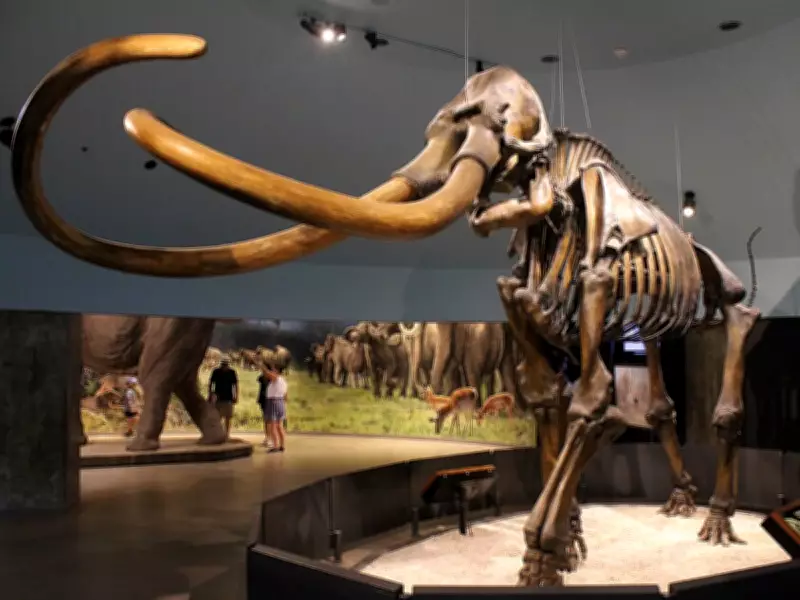
One fine spring day in 1978, two teenage boys from Texas were searching for arrowheads and fossils at a nearby stream. Instead of finding a small piece of flint, Paul Barron and Eddie Bufkin uncovered a huge bone protruding from the muddy waters near the banks of the Bosque River. This singular find has revolutionized our understanding of Ice Age prehistory.
According to the historical account maintained by the National Park Service, museum experts confirmed that the giant bone belonged to the femur of a Columbian mammoth. It was not just a lone bone but the beginning of what would become known as one of the most important Ice Age fossil sites in Texas. A total of 24 mammoths, along with other Ice Age mammals, were discovered at this location in Waco. An ordinary outing for two friends turned into a remarkable scientific discovery. The site has been declared a national monument, offering the public a chance to look back into history.
An Extremely Rare Prehistoric Nursery Herd
It did not take long for the magnitude of the findings to become apparent through careful excavations. These were not bones randomly collected over time but represented a well-preserved death assemblage—a group of animals that perished simultaneously. According to the National Park Service, the Waco Mammoth Site is unique because it contains the only nursery herd of Columbian mammoths known to have been found anywhere in the United States. A nursery herd consists of females and juveniles that move together as a tight family. This formation resembles the close family groupings observed among modern-day elephants.

Roughly 65,000 to 70,000 years old, the findings provide a glimpse into the life of mammoths and their unexpected demise. The fossil remains show at least three different ages of mammoths present at the location, including the remains of an adult male, allowing for unique insights into herding habits.
Reconstructing Ice Age Behavior
To understand the importance of this discovery, it is useful to note the specifics of the animals themselves. The discovered animals were Columbian mammoths, which had their own unique evolutionary branch in North America and were quite different from their well-known woolly relatives. Columbian mammoths were larger, adapted to warm climates, and dominated the southern lands of ancient times.
The presence of a whole nursery herd gives researchers the opportunity to move beyond studying mammoth anatomy to studying their behavior. A study published in Genome Biology claims that evolutionary research on mammoth lineages and habitats helps us understand how mammoths adapted to rapid environmental changes. Physical aspects of the site provide information about family movement and how they ended up at this location.
Of course, the exact cause of the catastrophe still requires research. However, the remains clearly show how it happened—researchers have proposed sudden rising water or flooding, but the exact cause remains debated. The site preserves mothers with their calves at this very spot.
The Reason for Keeping the Bones in Texas
Following the discovery, a significant decision was made to protect the site for future generations. Instead of excavating the bones and dispersing them to other museums, Baylor University employees and local volunteers decided that the fossils should remain at the location where they were discovered.
This conservation effort has helped preserve the complete scientific environment around the bones. Tourists can now visit the site and peer down into the excavation point, viewing the fossils in the same position as they were tens of thousands of years ago.
This remarkable discovery continues to provide invaluable insights into the Ice Age, offering a window into the lives of these magnificent creatures and the world they inhabited.