

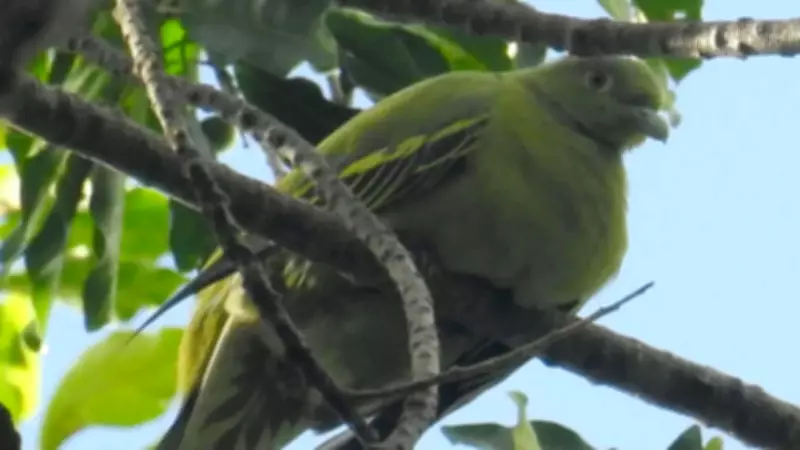
Coinciding with the 100th birthday of legendary British naturalist David Attenborough, grim news has emerged about one of the world’s rarest birds: the Timor green pigeon is sliding toward extinction.
What Is the Timor Green Pigeon?
Hidden deep in Timor-Leste’s shrinking forests, the Timor green pigeon (Treron psittaceus) is so rare that encountering it in the wild is a stroke of luck. With bright green feathers resembling an unripe mango, this bird is on the edge of extinction. Scientists estimate fewer than 500 individuals remain, and without urgent intervention, they could vanish within a few years.
The warning comes from a major study published in the journal Oryx by researchers from Charles Darwin University and BirdLife International. They describe this as the strongest evidence yet that the Timor green pigeon’s population is rapidly collapsing within its already tiny range.

Historically, the species inhabited several islands in eastern Indonesia and Timor-Leste. Today, it is confined to remote forest patches in Timor-Leste’s Lautem District. Experts believe it is now “functionally extinct” in Indonesia, meaning too few pigeons are left for recovery without significant changes.
A Bird Found Nowhere Else
According to Earth.com, the Timor green pigeon belongs to the Columbidae family, like common pigeons and doves, but it depends entirely on tropical lowland forests and fruit trees for survival. Many island pigeons are at risk because they are adapted to isolated habitats and cannot cope with sudden environmental changes.
Ironically, the bird’s noisy wingbeats and tendency to feed openly in fruit trees make it an easy target for hunters.
What Caused the Collapse?
The study identifies hunting as the primary reason for the pigeon’s near extinction. Hunters target them for meat, especially when they gather in groups at fruit trees. When one pigeon is shot, the others often remain instead of fleeing, allowing hunters to kill multiple birds at once.
Forest loss exacerbates the problem. Decades of deforestation in Timor have reduced breeding and feeding habitats, leaving remaining birds scattered and vulnerable.
Dr. Colin Trainor, who led the study, has observed the crisis over two decades. He recalls easily spotting the birds in 2002, but after years of surveys, sightings have plummeted. The research team logged over 1,400 survey days from 2002 to 2025 across the pigeon’s former range. Out of just 96 sightings, almost all recent ones came from a single area in Nino Konis Santana National Park. Even protected lands have not been enough to save the birds.
Why Are Scientists Sounding the Alarm Now?
The study highlights how quickly the pigeon has disappeared from its previous habitats. Sightings from Indonesian West Timor were common before 2000, but now the population is concentrated solely in Timor-Leste. Researchers have found almost no evidence of healthy populations in Indonesia recently.
Official estimates once placed the global population at up to 2,000 birds, but new research suggests the real number is likely between 100 and 500. This places the Timor green pigeon in dire straits.
Conservationists are urging the International Union for Conservation of Nature (IUCN) to reclassify the species as Critically Endangered, hoping to attract more attention and funding. Alex Berryman from BirdLife International warns that this could be one of the most likely extinctions in Wallacea, a region renowned for its unique biodiversity.
Is There Still Hope?
Despite the bleak outlook, researchers believe extinction is not inevitable. Most remaining pigeons live in one last stronghold within protected forests in Timor-Leste. Scientists say urgent cooperation between governments, conservation groups, and local communities could still save the birds.
A key goal is to reduce hunting through education and financial incentives for local residents. Researchers think just a small number of hunters are responsible for most of the losses.
Conservationists also call for better monitoring, expanded protected habitats, and increased biodiversity investments in Timor-Leste, which is often overlooked in international funding.

For now, the Timor green pigeon still calls out in remote forests, its wingbeats echoing through the canopy. But scientists warn that the clock is ticking. If action does not come soon, one of Southeast Asia’s rarest birds may disappear without most people ever realizing it existed.





