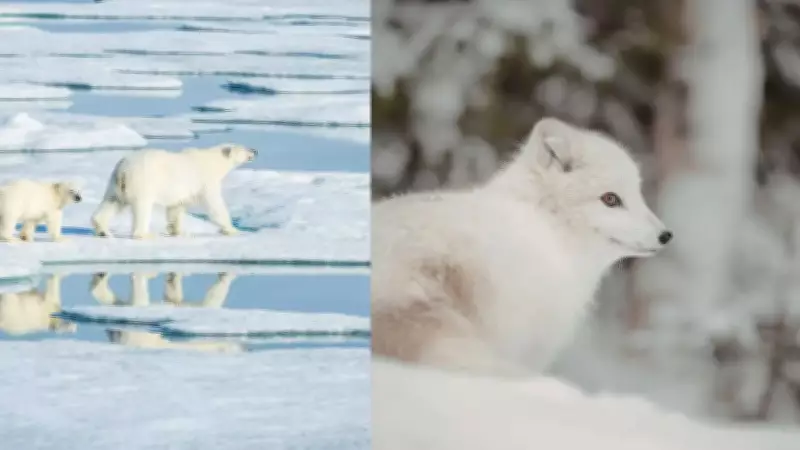
There is no denying that nature holds some of the best-kept secrets, and these snow animals are among the most unique creatures worth knowing. Our planet has extremely cold regions where one might assume nothing can survive. Yet, some of the most amazing animals call these icy places home. They do not merely survive; they actually thrive in these harsh environments. Their bodies are specially designed to live in the cold permanently.
The Narwhal
The Narwhal inhabits the waters of the Arctic. These creatures spend their lives swimming beneath thick ice, surfacing for air through small holes in the ice. The male Narwhal possesses a long tusk that functions like a highly sensitive tooth. The Narwhal uses this tusk to sense the surrounding water, detecting temperature and salinity levels to navigate and find food.
The Emperor Penguin
When temperatures drop, most penguins migrate to warmer areas. However, the Emperor Penguin heads directly into the cold. They are the only warm-blooded animals that breed during the harsh Antarctic winter. They endure fierce winds and extreme cold. To stay warm, the Emperor Penguin has four layers of scale-like feathers. Additionally, their specialized nose helps retain body heat, preventing it from escaping into the frigid air.

The Arctic Fox
The Arctic Fox is renowned for its exceptionally warm fur. Its body is built for heat conservation, featuring short legs and small ears that minimize heat loss. The Arctic Fox has a compact body that retains warmth efficiently. Its fur changes color with the seasons: in summer, it blends with rocks, and in winter, it turns white to match the snow, providing camouflage from predators and prey alike.
The Antarctic Icefish
The Antarctic Icefish lives beneath the ice in Antarctic waters. It is the only vertebrate with transparent blood. The Antarctic Icefish produces a special protein that prevents its body from freezing. This antifreeze protein stops ice crystals from forming inside its body, protecting the fish from harm and allowing it to survive in subzero temperatures.
The Polar Bear
The Polar Bear is the largest land carnivore and is perfectly adapted to life on Arctic ice. It hunts seals on the ice and is an excellent swimmer. The Polar Bear has a thick layer of blubber under its skin for insulation. Although it appears white, its fur is actually transparent and reflects light. The Polar Bear's skin is black, which helps absorb heat from the sun to keep warm.
The Musk Ox
Weighing up to 340 kilograms, the musk ox is a stocky giant from the last Ice Age that still roams the northern tundra. Their secret to surviving freezing winds is an incredibly thick double coat, featuring an underwool called 'qiviut' that is eight times warmer than sheep's wool. When winter storms hit or predators approach, these animals form a tight defensive circle around their calves. They use their massive bodies and heavy, curved horns to face down the wind and predatory wolf packs.