

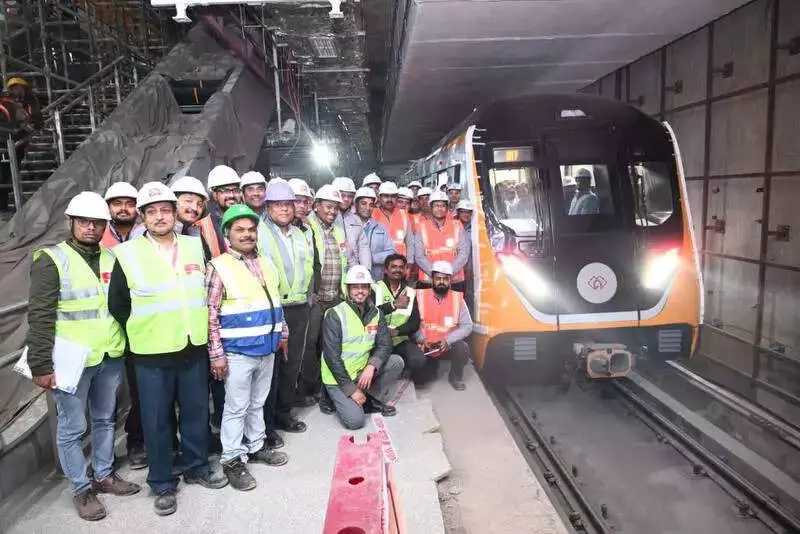
In a significant stride towards enhancing urban mobility, the Agra Metro project has marked a crucial milestone with a successful trial run on a key section of its first corridor. The Uttar Pradesh Metro Rail Corporation (UPMRC) successfully operated a train on the up line, connecting Mankameshwar to the Inter-State Bus Terminal (ISBT).
Milestone Achieved: Trial Run and Track Completion
Following the successful commencement of operations on the priority section, UPMRC engineers conducted the vital trial run. The metro train journeyed from Mankameshwar station to ISBT, navigating through several important intermediate stations. These included SN Medical College, Agra College, Raja Ki Mandi, and RBS College Metro Station. This test operation is a critical step in ensuring system safety and integration before public services begin.
In a parallel development, immediately after the trial run, the corporation announced the completion of track-laying work on the corresponding down line for this section. This achievement keeps the ambitious project firmly on schedule.

Systems Integration and Corridor Two Progress
The physical tracks are just one part of the complex metro ecosystem. UPMRC officials confirmed that work on several other essential systems is progressing simultaneously. This includes installation of the third rail (which supplies power to the trains), signalling systems, and other operational controls. The integration of these components is vital for the automated and safe running of the metro network.
Meanwhile, construction on the second corridor of the Agra Metro is also advancing rapidly. This line will connect Agra Cantt to Kalindi Vihar. Authorities are pushing the pace to ensure timely completion of the entire project, aiming to deliver a world-class metro system to Agra's residents and visitors.
Underground Construction: A Technical Insight
The construction methodology for the underground sections of the metro involves a precise, multi-stage process. Engineers first build the station structure. Once this is ready, a launching shaft is constructed to deploy a Tunnel Boring Machine (TBM).
The TBM then excavates the circular tunnel. However, this circular shape presents a challenge for laying traditional railway tracks. To overcome this, engineers first cast flat track slabs inside the tunnel. Subsequently, ballastless tracks are laid on these slabs, providing a stable and precise guideway for the metro trains. This modern technique ensures a smoother ride and requires less maintenance.
This series of advancements underscores the comprehensive effort to transform Agra's transportation landscape. The successful trial run and track completion bring the city one step closer to enjoying the benefits of a modern, efficient, and eco-friendly metro rail system, promising to decongest roads and offer a reliable commuting alternative.






