

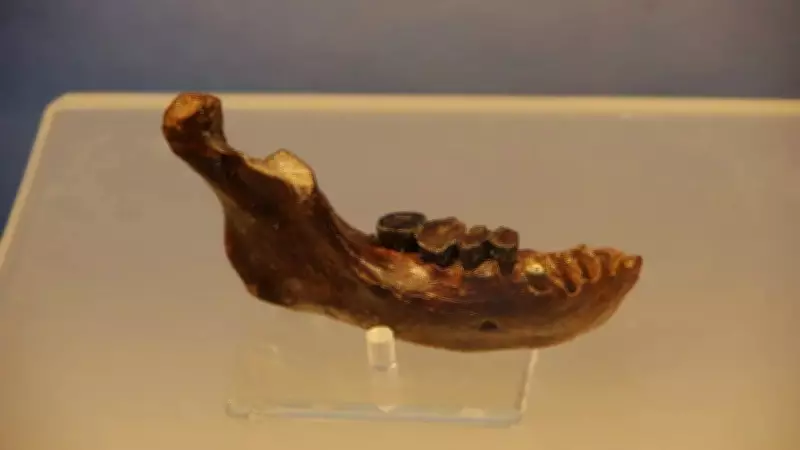
A jawbone like this was never expected to matter so much. It emerged from the seabed off Taiwan, quiet and unremarkable at first glance, almost easy to overlook. For years, it sat in collections as an uncertain fragment, something that did not quite belong anywhere in the human story. There were no clear signs, no obvious connection to any famous ancestor. Instead, it brought confusion and a host of unanswered questions concerning early human evolution and migration patterns across ancient Asia.
The fossil, now known as Penghu 1, is linked to the mysterious Denisovans, a group still largely reconstructed from genetics rather than from complete skeletons. Suddenly, this fragment is no longer just a broken piece of bone. It is becoming a rare physical window into a species that has remained almost invisible in the fossil record, hinting at what they might have looked like and how far across Asia they may have once lived.
A Strange Human Jaw Found Among Ice Age Animal Bones off Taiwan
According to PBS reports, the Penghu jawbone was first discovered during work in the Penghu Channel near Taiwan. It was recovered from the seabed along with other animal remains, suggesting the area was once dry land during ancient ice age periods when sea levels were lower. Initially, the fossil did not reveal much. Scientists struggled to assign it to any known human species. It carried a mix of features that did not fit neatly into established categories, leading to years of debate and uncertainty.

Only later did new methods of analysis begin to change the picture. Instead of relying purely on bone structure, researchers examined preserved proteins inside the fossil. These molecular traces began to suggest a connection that had not been clearly identified before. The jawbone might belong to a Denisovan male who lived somewhere between 200,000 and 40,000 years ago.
The Denisovans: A Human Species Still Largely Hidden
As reported by The Natural History Museum, the first trace of the Denisovans was made in 2010 through the discovery of their remains in Denisova Cave in Siberia. Since then, the Denisovans have been considered one of the most enigmatic human groups found by researchers. While Neanderthals have provided ample skeletal remains and artifacts for research, the fossil record for the Denisovans is quite scarce.
Much of the information that scientists have on the Denisovan population comes from genetic testing rather than from the discovery of bones. Genetic studies have revealed that the Denisovans intermingled with early humans and exchanged genes that can be found in some people today, particularly in Asia and Oceania, sometimes helping them adapt to high elevations.
However, despite having genetic information, very little is known about their morphology. To date, scientists have only identified a few teeth, bone fragments, and now the Penghu jawbone as possible proof of the Denisovans' existence.
What the Penghu Jawbone Might Reveal
Based on observations, the Penghu 1 seems to have robust mandibles with huge teeth. The Penghu 1's features appear to be similar to other possible Denisovan fossils found in China and Tibet, one of them being Xiahe. This kind of test can help confirm the identity of a certain fossil. As observed from the study, proteins found in the fossil remain similar to other samples that belong to the Denisovan species. Although researchers do not see this as a conclusive finding, at least they see it as supportive proof.
There are other physical characteristics that provide hints. A case in point is the sturdy jaw bones that are able to handle tough mastication processes. According to experts, this may suggest that the Denisovan people had strong facial muscles. Yet again, it is unclear whether this trait applied to both sexes or only to males.
Another aspect that adds to the mystery of the Penghu 1 is the environment where the fossil was located. It is likely that the area would have provided pathways between islands and mainland Asia, especially during ice ages.

From Siberia to Taiwan: Rethinking Denisovan Geography
The most unique implication of this discovery is the possible range of Denisovans. The recent fossils and genetic evidence reveal that they were not limited to a single region but rather may have spread across vast parts of Asia, from Siberia in the north to Taiwan in the south. This challenges earlier assumptions that different ancient human groups were more geographically restricted. Denisovans were adaptable, capable of surviving in both cold northern environments and warmer, forested regions.
Experts also point out that this flexibility may have played a role in their survival over long periods of time, even if they eventually disappeared as a distinct group.





