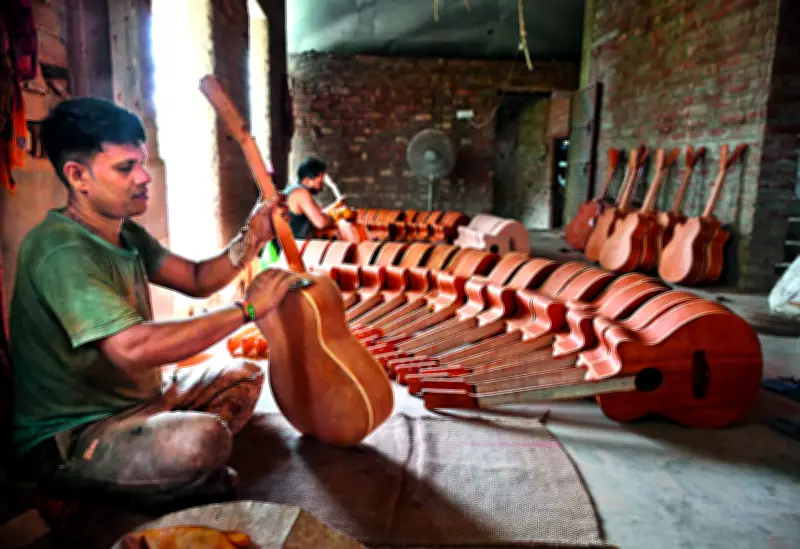
An hour from Kolkata, a village absent from tourist maps supplies acoustic guitars to Nepal, Bangladesh, Sri Lanka. Welcome to Guitar Gram. In Chanditala, Shyamnagar, Monday begins with the scrape of hand tools and the whine of polishing wheels. No signboards mark the spot, yet inside, guitars stack up as workers shape necks and spray paint the bodies. Many have never played a chord, but their work travels to cities like Delhi, Bangalore, and Jaipur. Somewhere, a musician plays one – unaware of its maker, but moved by its sound.
How it all began
Guitar Gram didn't name itself – the tag came from a blogger around 2020–21, and as the video spread, so did visitors, enquiries and orders from places that had never heard of Chanditala. The craft, though, dates to the late 1990s, when a guitar company craftsman began teaching finishing and polishing locally. “He said he would do something different,” recalls craftsman Govinda Biswas. “He took some of our boys under his wing… Then he started going out to get buyers. We saw that we could sell. That's how we started the factory.” The first units came up before the year 2000, expanding through the decade. Craftsman Shekhar Roy says, “I was one of the first to start my own workshop. I learned the craft and its nuances working in many workshops. I started my own enterprise in 2007, and continue to create guitars every day.”
Recently, we had a large offer from Dubai but couldn't take it on; logistics, advance payment and the numbers didn't work. That's the core issue – after raw material, labour and freight, we're left with maybe ₹200 per guitar, says Rajesh Biswas, manager.

Wood, wire & wage
What's produced here is almost entirely acoustic. Little is local except labour. The wood arrives from Kerala, Assam and Gujarat, while finished guitars move by road, with a delivery to Nepal by trucks costing ₹50,000–₹60,000. The supply chain stretches across India: Red Cedar costs ₹1,200 per cubic foot, Rosewood ₹8,000–₹12,000, Maple upwards of ₹3,000, alongside pine and mango wood. Strings come from Gujarat, bags are stitched at a different workshop in the village. The hardware ranges from ₹250 pegs to ₹3,000 sets. Branding is strategic: while they sell their own local brand, and others OEM for Nepali brands or white-label for Indian markets.
This is our busiest time. Exams are over, children are home and parents want them to learn something new. Orders come in from shops and direct buyers. Whatever is made goes out the same day. It's tough to keep up, but it's a good problem to have, says Khokan Roy, workshop owner.
The craftsmen: Neither musician nor machine
Perhaps the most striking fact about Guitar Gram is this: most makers cannot play. “The people who make guitars don't play the guitar,” says worker Sanjay Golda. Craftsman Nitish Bala adds, “The work is done by hands… one person doesn't know everything.” Production is cellular – body, neck, fingerboard, polish and hardware are handled separately, and mastering all stages takes years. “If you want to be a good craftsman, it takes five years,” says Shopal Biswas. “You can't make good sound by working fast.” The workforce is young, largely male, working long hours, with 200–300 families linked across 8–12 factories. Attrition remains high as workers leave for better-paying jobs.
We export to Nepal and Bangladesh. Our highest orders are from Nepal. We were shipping to the US online, parcels going regularly, but that stopped after Trump's government, says Gobindo Biswas, factory owner.
Numbers behind the notes
The scale is easy to underestimate. Across roughly a dozen factories in Chanditala, with a secondary cluster in Keutia, Guitar Gram produces over 15,000 guitars a month, with units turning out 200–900 pieces depending on size and orders. Factory-gate prices range from ₹2,500 to ₹4,500, while solid-top builds cross ₹7,000–₹8,000; retail prices often triple. Costs stay tight at ₹1,500–₹1,700 per basic unit. A skilled craftsman needs two days per guitar, but batch production yields 100–250 a week. “Nepal remains the largest export market followed by Sri Lanka. Guitars made by us also find a home in many Indian cities like Delhi and Jaipur. We get nearly 400–450 orders monthly,” said Rajesh.