

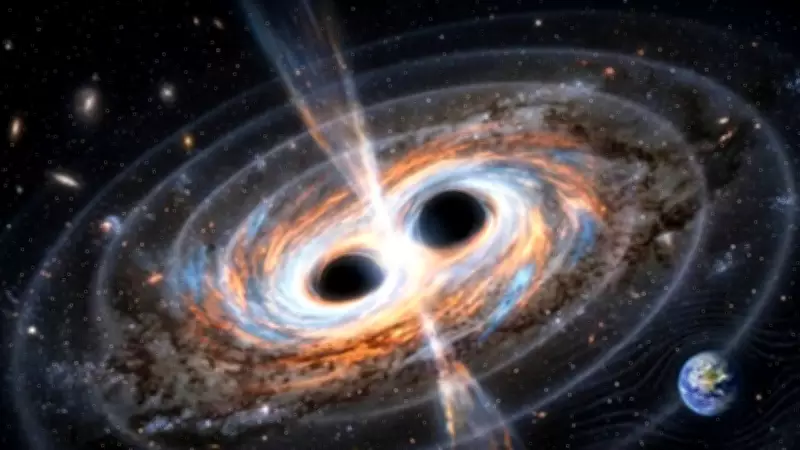
Supermassive Black Hole Binary System Discovered, Set to Merge in a Century
In a groundbreaking astronomical breakthrough, scientists have directly identified a supermassive black hole binary system—two colossal black holes orbiting each other—in the final stages of orbital decay. This discovery, marking a first in astronomy, involves two supermassive black holes located at the core of the galaxy Markarian 501, approximately 450 million light-years from Earth.
Massive Objects in a Tight Orbit
Each of these black holes boasts a combined mass ranging from 100 million to 1 billion solar masses, equivalent to the mass of our Sun. They are locked in a tightly bound binary orbit, with researchers predicting that their merger could occur within the next 100 years, as detailed in a study on SKYCR. Although this cosmic collision is far from Earth, the energy released will send gravitational waves rippling through the fabric of space-time, detectable by future instruments on our planet.
Challenging Previous Beliefs with New Evidence
An international team of scientists, led by Silke Britzen from the Max Planck Institute for Radio Astronomy in Germany, made this discovery by identifying a second particle jet in the core of Markarian 501. This challenges the prior assumption that only one jet existed. By analyzing high-resolution radio data collected over 23 years, researchers observed that the second jet orbits the first, exhibiting periodic helical motion and precession. This provides direct evidence of two supermassive black holes bound by extreme gravitational interactions.

Why 100 Years is an Astronomical Blink
The distance between these black holes is remarkably small, only 250 to 540 times the distance between Earth and the Sun, considered a very tight orbit for such massive objects. Based on their 121-day orbital period, energy is rapidly dissipating from the system. Depending on their masses, a merger into a single entity is projected within 100 years—a fleeting moment in astronomical terms. This timeframe offers humanity a unique opportunity to observe the 'final parsec' problem, exploring how binary systems overcome barriers to coalescence.
Impact on Earth and Gravitational Wave Detection
The eventual merger will unleash a burst of energy, primarily as gravitational waves. While posing no direct danger to Earth, these waves will create periodic strains in space-time, detectable as ripples traveling at light speed. Gravitational waves are expected to be picked up by Pulsar Timing Arrays (PTAs) even before the collision. As the black holes approach merger, the frequency of these waves will increase, allowing astronomers to record what may become one of the most significant events in gravitational radiation history.
A Rare Window into Cosmic Evolution
This exciting discovery opens an incredibly rare window into the later stages of galaxy formation and the birth of a new supermassive object. It not only advances our understanding of black hole dynamics but also sets the stage for unprecedented observations in the coming decades, potentially reshaping our knowledge of the universe's fundamental processes.






