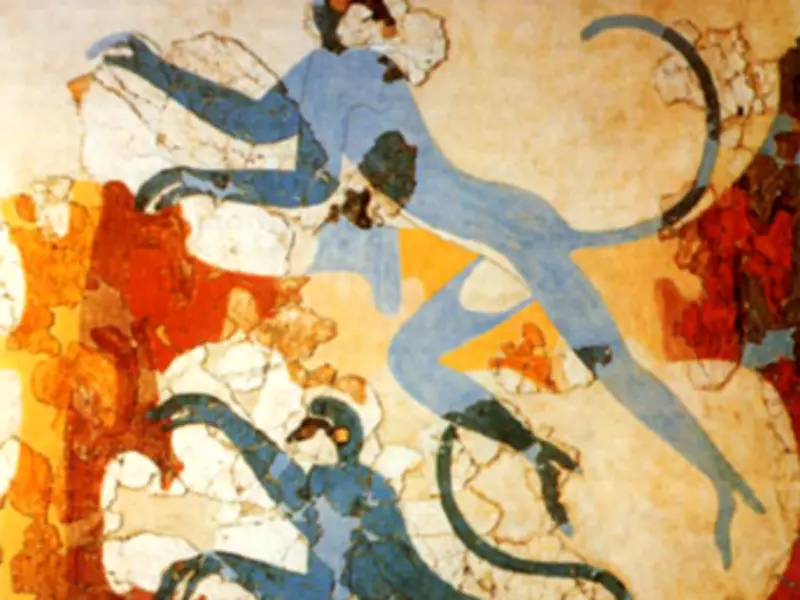
Imagine brushing away mounds of dark volcanic dust, expecting nothing more than dirt, only to find a brilliantly colored blue monkey peering back from a wall painting hidden for thousands of years. This is what happened in 2001, when archaeologists were excavating the remains of Akrotiri on the island of Santorini in Greece. Workers were busy removing layers of volcanic ash when they came upon an amazing wall painting. For millennia, this stunning piece of art had been concealed from human eyes. The discovery was soon recognized as a striking example of how a natural disaster can preserve art for future generations.
A City Sealed in Volcanic Ash
Akrotiri was a thriving city that was buried by a volcanic eruption. Nevertheless, the layer of ash played the role of a protective barrier for the city and its inhabitants. For many years, archaeologists have been painstakingly digging through layers of ash. Rather than intact structures standing freely in open air, what is usually unearthed are fragmentary pieces of plaster and shattered remains of frescoes. What made the 2001 discovery so unusual was that a large section of the painting was exposed in situ rather than broken into pieces. This means that the recovery of ancient Akrotiri is slow and cautious work. The artworks survived because ash covered them quickly, and today scientists uncover them little by little with great patience.
The Puzzle of Blue Monkeys
What makes the painted animals on this wall so significant is that they were real and valuable to the ancient world. The painted creatures are depicted in blue and move through a stylized landscape. What makes this painting especially interesting to historians is the fact that these particular animals were not naturally found in Greece. Their depiction suggests connections with distant civilizations such as Egypt or Asia. As stated in a scholarly article indexed in PubMed, researchers worked for years to discover the exact kind of the monkey and their representation through color and shape. The article argues that the painting is key to understanding how people in the Aegean civilization perceived and represented the world. It shifts the discussion from decoration to ancient long-distance contact and exchange.

Locating the Exact Room
In archaeology, an object is far less informative when experts cannot identify exactly where it was found. However, the blue monkey fresco was found in a specific location at the excavation site. In another peer-reviewed scholarly article indexed in PubMed, the author states that the blue monkey fresco was found in Room 6 of Building Complex Beta in Akrotiri. Knowing the exact room helps historians learn more about the people who lived there. In this way, the painting becomes more than a generic museum artefact; it is part of an actual Bronze Age house. This information helps scholars reconstruct the room's function, the people who lived there, and how art fit into their lives.
From Field Discovery to Historical Artefact
The 2001 discovery highlights the patient, methodical nature of archaeological research. Breakthrough discoveries usually come not from dramatic flashes of inspiration but from painstaking labor, careful clearing, and the rapid preservation of artefacts that can deteriorate once exposed to air. At present, the blue monkeys of Akrotiri remain of interest to both tourists and scholars. They have gone from unexpected underground finds to a subject of study and university lectures. Because volcanic ash buried the town, many of its most impressive artefacts were preserved, offering a glimpse into the artistry of the ancient world.