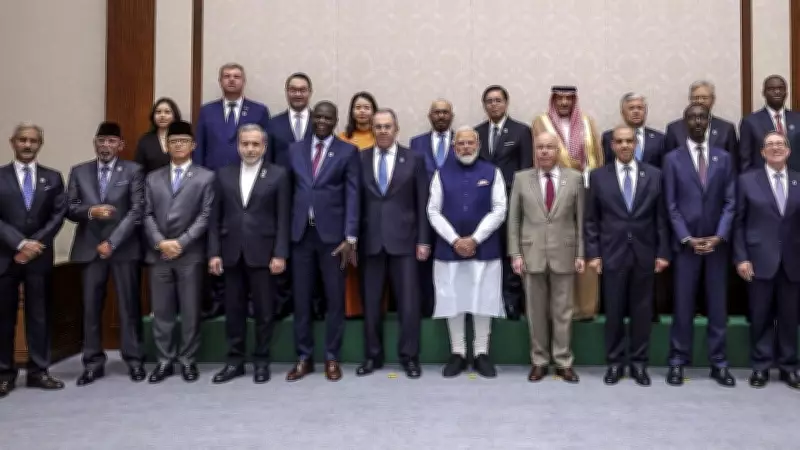
At the BRICS foreign ministers' meeting held in New Delhi, Iran launched a sharp criticism against the United Arab Emirates, accusing it of colluding with Israel and the United States. The remarks came during the gathering of the bloc's top diplomats, which also included discussions on expanding the group's influence and addressing global challenges.
Iran's Accusations Against UAE
Iran's Foreign Minister, Hossein Amir-Abdollahian, stated that the UAE's recent normalization of ties with Israel undermines regional stability and violates the principles of the BRICS group. He emphasized that such actions are detrimental to the collective interests of the member nations, particularly in the context of the Palestinian issue. The Iranian minister urged the UAE to reconsider its stance and align with the broader consensus against Israeli policies.
UAE's Response and Bloc Dynamics
The UAE delegation, led by Foreign Minister Sheikh Abdullah bin Zayed Al Nahyan, defended its position, arguing that engagement with all parties, including Israel, is necessary for achieving peace and security in the Middle East. The UAE emphasized that its foreign policy is based on national interests and that it remains committed to the Palestinian cause. The exchange highlighted the growing divisions within BRICS, as member states navigate complex geopolitical landscapes.

Broader Agenda of the Meeting
Beyond the Iran-UAE spat, the BRICS foreign ministers focused on several key issues:
- Expansion of BRICS: The ministers discussed the potential inclusion of new members, with several countries expressing interest in joining the bloc. A consensus was reached on the criteria for expansion, aiming to enhance the group's global representativeness.
- Economic Cooperation: Talks centered on increasing intra-BRICS trade and investment, reducing reliance on the US dollar, and promoting the use of local currencies in bilateral transactions. The ministers also explored ways to strengthen the New Development Bank.
- Global Governance Reform: The ministers called for reforms in international institutions such as the United Nations and the World Trade Organization, advocating for a more equitable representation of developing nations.
- Climate Change and Sustainable Development: BRICS countries reaffirmed their commitment to the Paris Agreement and discussed collaborative efforts to address climate change, including technology transfer and financing for green projects.
- Counterterrorism and Security: The ministers emphasized the need for joint action against terrorism, extremism, and cyber threats. They also addressed regional conflicts, including the situations in Afghanistan, Ukraine, and the Middle East.
Significance of the Delhi Meeting
The BRICS foreign ministers' meeting in Delhi is seen as a precursor to the upcoming BRICS summit later this year. The meeting underscored the group's ambition to play a more prominent role in global affairs, challenging the dominance of Western-led institutions. However, the internal discord between Iran and the UAE highlights the challenges BRICS faces in maintaining unity amidst divergent foreign policy orientations.
Observers note that while BRICS members share common goals of economic development and multipolarity, their individual geopolitical interests often lead to friction. The ability of the bloc to manage such differences will be crucial for its future cohesion and effectiveness.
Outcome and Next Steps
The meeting concluded with a joint statement that, while not explicitly referencing the Iran-UAE dispute, reaffirmed the principles of mutual respect, sovereignty, and non-interference. The ministers agreed to continue discussions on expansion and economic cooperation at the next summit. The Indian chairmanship was praised for facilitating a productive dialogue, despite the underlying tensions.
As BRICS moves towards its next summit, the focus will be on translating the discussions into concrete actions. The group's ability to present a unified front on key global issues will be closely watched by the international community.