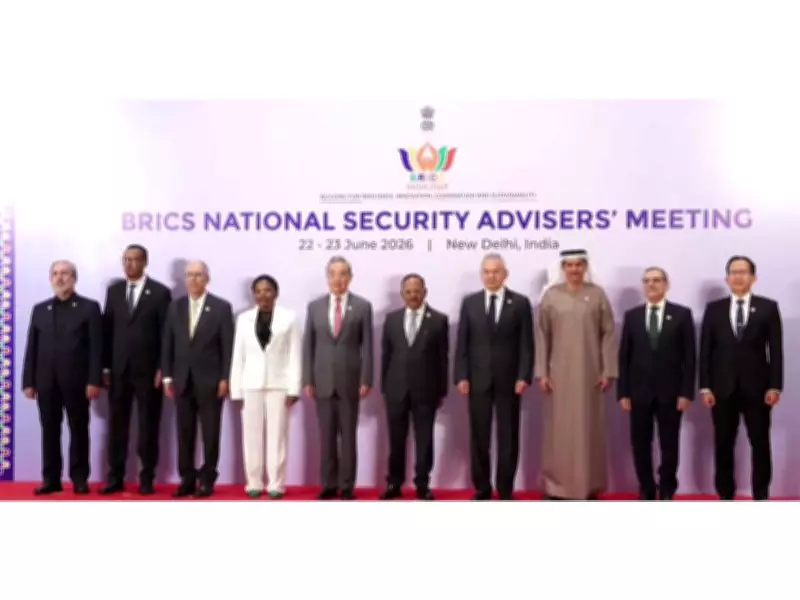
The BRICS National Security Advisers' meeting commenced on Tuesday in New Delhi, with India's National Security Adviser Ajit Doval welcoming Chinese Foreign Minister Wang Yi, Russian Security Council Secretary Sergey Shoigu, and Iran's Deputy Secretary of the Supreme National Security Council Ghadir Nezamipour. A group photo of all participating security heads was taken following the welcome.
Arrival of Russian Security Council Secretary
Russian Security Council Secretary Sergey Shoigu arrived in India on Tuesday to attend the 16th BRICS National Security Advisers meeting. The Russian Embassy in India confirmed his arrival via a post on X, stating: "Secretary of the Security Council of Russia Sergey Shoigu arrived in India to participate in the Meeting of BRICS National Security Advisors."
Day Two of the Meeting
Tuesday marks the second day of the BRICS National Security Advisers Meeting, chaired by NSA Ajit Doval. According to the Ministry of External Affairs (MEA), the NSAs and heads of delegation from BRICS member countries will exchange views on the theme "Non-traditional security challenges confronting the world today." Discussions will also cover the rapidly evolving nature of national security threats and the role of emerging technologies in shaping new security challenges.

Review of Joint Working Groups
The meeting is expected to include a review of the outcomes of the recently held BRICS Joint Working Groups on Counter-Terrorism and on Security in the Use of Information and Communication Technologies.
India's BRICS Chairship
India's BRICS Chairship in 2026 is its fourth, having previously held the position in 2012, 2016, and 2021. The Chairship is guided by the theme "Building for Resilience, Innovation, Cooperation and Sustainability," reflecting a people-centric and humanity-first approach articulated by Prime Minister Narendra Modi at the 2025 Rio Summit.
BRICS Membership and Agenda
BRICS currently brings together eleven major emerging economies: Brazil, China, Egypt, Ethiopia, India, Indonesia, Iran, Russia, Saudi Arabia, South Africa, and the United Arab Emirates. The grouping serves as a platform for consultation and cooperation on global and regional issues, as well as global political and economic governance. According to the official BRICS 2026 website, the agenda has expanded from its original focus on economic issues to three core pillars: political and security cooperation, economic and financial cooperation, and cultural and people-to-people exchanges. BRICS cooperation now covers counter-terrorism, climate change, food and energy security, international financial architecture, telecommunications, agriculture, labour and employment, trade, and WTO-related matters.
Expected Outcomes
The BRICS NSAs meeting is expected to strengthen coordination among member countries on key security and strategic challenges facing the global order.