

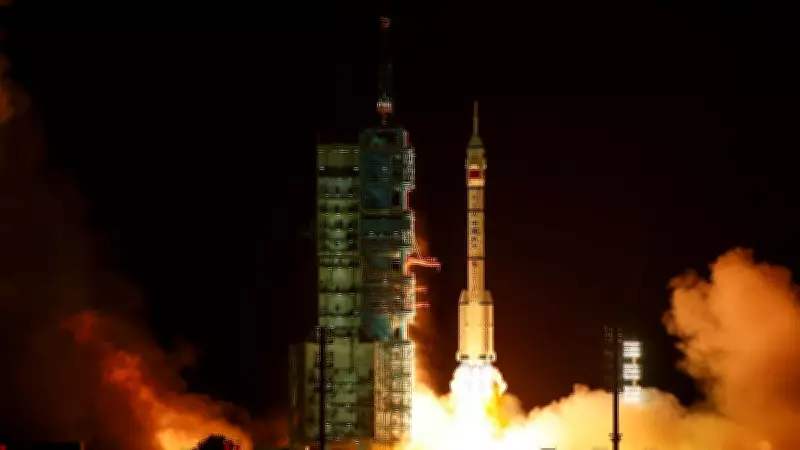
China has launched a new crewed mission to its Tiangong space station, with one astronaut set to remain in orbit for a full year. This mission is part of China's ambitious space program, which includes a planned crewed lunar landing by 2030.
Mission Details
The three-person crew lifted off from the Jiuquan Satellite Launch Center in the Gobi Desert. One of the astronauts will stay aboard the Tiangong station for approximately 12 months, making it one of the longest single spaceflights in history. However, it remains short of the 14-and-a-half-month record set by Russian cosmonaut Valeri Polyakov in 1995 aboard the Mir space station.
Strategic Goals
This extended mission is a critical step for China as it develops its deep-space capabilities. The country aims to land astronauts on the moon before the end of the decade, a goal that requires mastering long-duration life support, radiation protection, and in-orbit operations. The Tiangong station, completed in late 2022, serves as a testbed for these technologies.

The mission also underscores China's growing presence in space, as it operates its own space station independently of the International Space Station (ISS), which is led by the United States and Russia. China has been excluded from the ISS due to U.S. concerns over technology transfer and national security.
International Context
China's space program has advanced rapidly, with robotic missions to the moon and Mars, and now human missions of increasing duration. The year-long stay will provide valuable data on the physiological and psychological effects of prolonged spaceflight, essential for future lunar and interplanetary voyages.
The crew includes experienced astronauts who have undergone extensive training for the extended mission. They will conduct scientific experiments, maintain station systems, and test new technologies during their stay.
Looking Ahead
China has announced plans to send astronauts to the moon by 2030, with a goal of establishing a lunar research station. This mission brings that goal closer, as it demonstrates the capability to sustain human life in space for extended periods. The success of this year-long mission will be a key milestone in China's space ambitions.






