

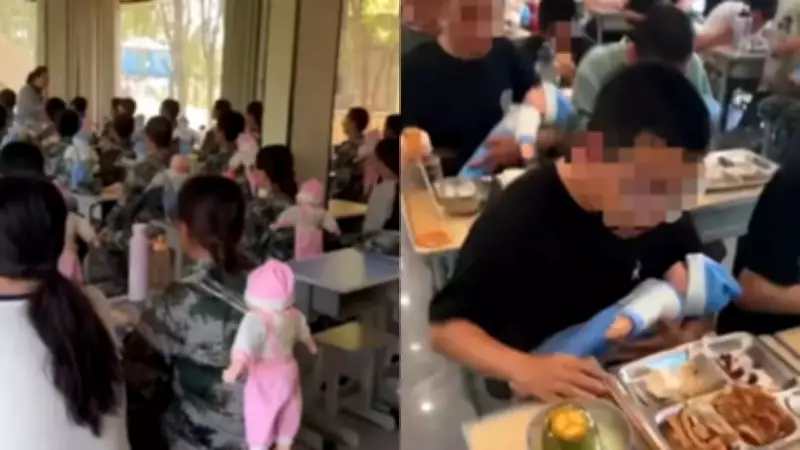
A special education school in eastern China has ignited controversy after introducing a unique lesson for teenagers that involves carrying baby dolls throughout the day. The Yuanzhong Special Education School in Xuzhou, Jiangsu province, employs this technique to foster empathy and responsibility among students who are often described as rebellious or struggling with behavioral issues, such as gaming addiction, lack of motivation, or family relationship difficulties.
Details of the Baby Doll Exercise
According to reports from the South China Morning Post, students are given baby dolls weighing around 2.5 kilograms and instructed to care for them during lessons, meals, and other activities. The exercise is physically demanding, with students required to hold the dolls constantly, feed them, and adjust their posture to keep them secure. Videos circulating on Chinese social media show students walking slowly, squatting, and carefully handling the dolls, highlighting the intensity of the simulation.
Teachers at the school believe this simulation helps students understand the struggles of parenting. One teacher explained that students can only appreciate their parents' efforts once they experience the responsibility of caring for a child, even if it is just a doll. The school principal, surnamed Du, defended the program, stating that the goal is to help students develop a more respectful attitude towards family life.

Mixed Reactions from the Public
The public reaction has been sharply divided. Some social media users support the idea, arguing that it may help teenagers develop patience and emotional awareness. They believe the exercise encourages students to think more carefully about responsibility and family relationships. However, others have raised concerns, suggesting the approach is too artificial and may not reflect real parenting. Critics point out that real babies cry and demand constant care, which dolls cannot replicate, making the exercise unrealistic.
There is also concern about the potential emotional impact on students. Some worry that the practice might induce negative associations with parenthood rather than nurturing empathy. Experts note that empathy involves complex elements that cannot be learned solely through simulation. Emotional learning occurs gradually through personal experience and relationships, and while some students may benefit from practical engagement, others may not respond positively.
Broader Context of Special Education in China
China's special education schools have often grabbed headlines for rigorous or unconventional educational approaches. These institutions typically focus on behavior management techniques. Yuanzhong Special Education School adopts a similar approach but frames it as emotional and moral education. The cost of enrolling a child in such schools is high, and parents expect behavioral changes after attendance.
The controversy highlights ongoing debates about the boundaries between education and emotional intelligence. While the baby doll exercise aims to teach gratitude and responsibility, it raises questions about the effectiveness of simulated experiences in fostering genuine empathy. As the discussion continues, educators and parents remain divided on whether such methods are beneficial or potentially harmful.






