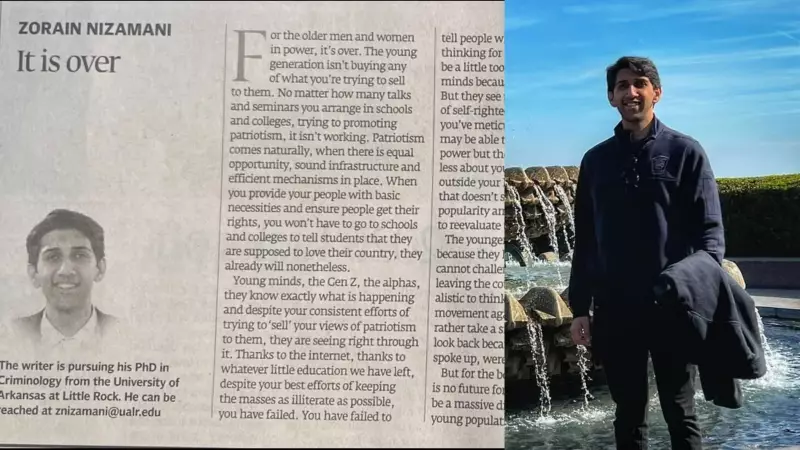
A single opinion piece, published and then swiftly erased, has ignited a fierce national conversation in Pakistan about freedom of speech, generational divides, and the state's relationship with its youth. The author, Zorain Nizamani, a Pakistani PhD scholar in criminology at the University of Arkansas, Little Rock, and son of actors Qaiser Khan Nizamani and Fazila Qazi, has unexpectedly become a focal point for dissent.
The Article That Disappeared
The op-ed, provocatively titled ‘It Is Over’, first appeared in The Express Tribune on January 1, 2026. Within hours, it was removed from the publication's website without any official public explanation. This rapid deletion, widely attributed to pressure from Pakistan's powerful military establishment, had a counterproductive effect. Screenshots of the column had already begun circulating wildly on social media platforms, ensuring its message reached a far wider audience than its original publication ever could.
In his writing, Nizamani articulated a profound and growing chasm between Pakistan's ruling elite and its younger citizens, specifically Generations Z and Alpha. He argued that the traditional tools long used by the state to mould public opinion and foster patriotism—such as mandatory seminars and nationalist messaging in educational institutions—have utterly lost their potency.

A New Generation's Defiance
Nizamani's core argument centred on the political awakening of Pakistan's youth. "For the older men and women in power, it’s over. The young generation isn’t buying any of what you’re trying to sell to them," he declared. He described these younger generations as politically alert, critically minded, and largely immune to official narratives, thanks to unfettered access to the internet and global information streams.
"Young minds, the Gen Z, the alphas, they know exactly what is happening… you have failed to tell people what to think, they are thinking for themselves," Nizamani wrote. He acknowledged the climate of fear, noting many are "too scared to speak their minds because they prefer breathing," but highlighted that silence does not mean acceptance. Instead, he pointed to a trend of quiet emigration—a "silent, quiet exit"—as a preferred alternative to direct confrontation with powerful institutions.
He redefined patriotism not as a sentiment to be enforced through slogans, but as a natural byproduct of good governance. "Patriotism comes naturally when there is equal opportunity, sound infrastructure and efficient mechanisms in place," he asserted, implying that the state's failures in providing these basics were the real threat to national loyalty.
Backlash and Amplification
The act of censorship itself became the strongest validation of Nizamani's thesis. The removal triggered immediate and sharp reactions from journalists, activists, and political groups across Pakistan's ideological spectrum. Rights activist Mehlaqa Samdani highlighted the irony, stating that the column's disappearance was "exactly the kind of censorship Zorain talks about."
The political party Pakistan Tehreek-e-Insaf (PTI), founded by Imran Khan, amplified the piece online, aligning its message with their critique of the establishment. "Gen Z sees corruption, inequality, and hypocrisy clearly. Without justice, jobs, and dignity, propaganda fails," they posted, co-opting the op-ed's themes for their political narrative.
Faced with a growing political storm, Nizamani issued a clarification on LinkedIn, attempting to distance his personal observations from partisan politics. "My article was based on my personal views and my take on things. I do not carry disdain against anyone; there is enough hatred in the world," he wrote, adding the poignant line, "truth is always controversial."
This episode underscores a critical moment in Pakistan's socio-political landscape. It is not merely about one deleted article but symbolizes the intense friction between an entrenched system and a digitally-native, disillusioned generation that is increasingly finding its voice, even when that voice is swiftly silenced by the powers that be. Zorain Nizamani, perhaps reluctantly, has become a symbol of this defiant new consciousness.